HK officers answer criticism for using excessive force
2014-10-27 08:49 Global Times
Web Editor: Qian Ruisha
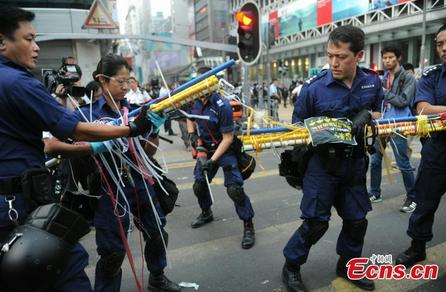
Hong Kong police remove blockades erected by Occupy Central students at a protest site in the bustling area of Mong Kok, Hong Kong on October 17, 2014. (Photo: ECNS)
Around 3 pm Thursday in Mong Kok, one of the three occupy protest sites in Hong Kong, a group of men arrived on Argyle Street.
They claimed that they had come "for justice" as they removed road blocks and other makeshift barricades to clear the street and force Occupy protesters to withdraw.
This move immediately provoked dissatisfaction from demonstrators. And just before the situation reached critical mass, hundreds of police rushed in the middle, hand in hand, separating the two sides.
This scene stands in contrast to the September 28 incident on Connaught Road, where lines of helmeted police officers carrying riot shields used tear gas and pepper spray to disperse the crowd.
Police hurled a total 87 tear gas grenades at protesters that day. At least 30 people were injured.
The incident sparked worldwide debate as to whether Hong Kong police have been using excessive force, or not enough to maintain control.
Stress points
"Over the past few weeks, my colleagues and I have been under extreme stress," a frontline police officer told the Global Times under condition of anonymity.
"Since the day that some of our colleagues used tear gas, I have encountered many protesters who said horrible things to me because they do not agree with what we did," he said.
Police had not used tear gas in Hong Kong since protests led by South Korean farmers against the World Trade Organization in 2005.
Secretary of Security, Lai Tung-kwok, said that the use of tear gas was necessary in order to "deal with crowds that may have gotten out of control and, therefore created a dangerous situation, or to stop and prevent crowds from continuing to charge at police so as to ensure public safety, restore social order and avoid injuries to both the crowds and the police officers."
He also argued that tear gas is "standard piece of police equipment for crowd control" in many European countries.
Protesters, however, condemned the police's decision.
"I think there were better ways to disperse the crowd other than using tear gas. Eighty-seven canisters is unacceptable," a volunteer surnamed Lai, who has been participating throughout the movement, told the Global Times. "The protesters were mainly unarmed students. The police should not have thrown tear gas into the crowd, which could cause people to panic and result in a stampede," said Lai.
According to a recent survey conducted by the Chinese University of Hong Kong's Centre of Communication and Public Opinion, 54 percent of the total 802 respondents agreed that it was "inappropriate to use tear gas" on September 28, while 22 percent called it an "appropriate act."
Gregory Lau Tat-keung, a former police superintendent, however, told the Global Times that the use of such force was "reasonable" given the number of police officers was relatively small compared to that of the demonstrators who had already barricaded the roads.
On October 19, a total of 23 days after the movement kicked off, a new clash broke out in Mong Kok. Police officers used batons to disperse the crowd, a move that left at least 20 people injured. Some demonstrators had to be carried away on stretchers and others treated for head wounds, broken bones and bruises, according to medics at the scene.
Police said in a statement on the same day that they had used minimum force as protesters "suddenly attempted to charge their cordon lines."
Steve Hui Chun-tak, chief superintendent of the Hong Kong Police Public Relations Bureau, explained that the batons were used for purely defensive measures.
"Police follow a strict manual on the use of force... As we observed, some activists were aggressively charging the police cordon. They had stolen, pushed and thrown metal barriers against police officers," he said.
A total 61 officers have been injured policing the protests as of October 23, according to Hui.
He was also concerned about the situation in Mong Kok where the protesters have become increasingly aggressive.
"This is an unlawful assembly. It is the responsibility of the police to take resolute measures to restore public order and public safety. The police officers could have arrested all of them, but the fact that they haven't has shown that the police have exercised a high level of restraint," Lau added.
Hurt feelings
The city has some 28,000 police officers, according to Hong Kong Police Force. However, the total number charged with handling the ongoing protests is unclear.
Reuters quoted a senior officer on October 18 as saying 400 to 500 officers had been charged with moving protesters back from a "key intersection."
During the WTO protests, which saw more than 10,000 participants, around 2,000 police officers were dispatched to the site, where pepper spray and batons were reportedly used.
Apart from suspicions of using excessive force against protesters, police also faced pressure following the series of violent clashes in Mong Kok.
Protesters accused police officers of favoring anti-Occupy protesters and joining forces with local triads to further stir the chaos.
Tensions intensified after footage of civic member and protester Tsang Kin-chiu being allegedly beaten by seven police officers went viral. The officers involved were immediately removed from their posts and the case is under investigation.
The phrases "Black Police" and "Police Triads" have since appeared on banners among protesters - accusations of police involvement with local mafia.
Lau, the former police superintendent, told the Global Times that the accusations have "hurt the feelings" of officers.
"It is heartbreaking to hear such labels... Those accusations were made with no evidence and are being used to deliberately defame Hong Kong police," Lau said.
He also said the police do not "execute power in favor of anyone."
"So it is also wrong to say that the police are a political tool of the Hong Kong government," Lau said.
The frontline police officer also told the Global Times that he felt hurt and disappointed when verbally attacked by protesters.
"Our work hours have at least doubled. This is tiring and particularly hurtful when it is our duty to maintain social order and protect citizens, but we are being taken as the government's political tool or a public enemy."
"Some people have asked me to quit, but my duty is to protect citizens, including protesters. If I quit, who is going to protect them? Who is going to maintain social order?" he asked.