



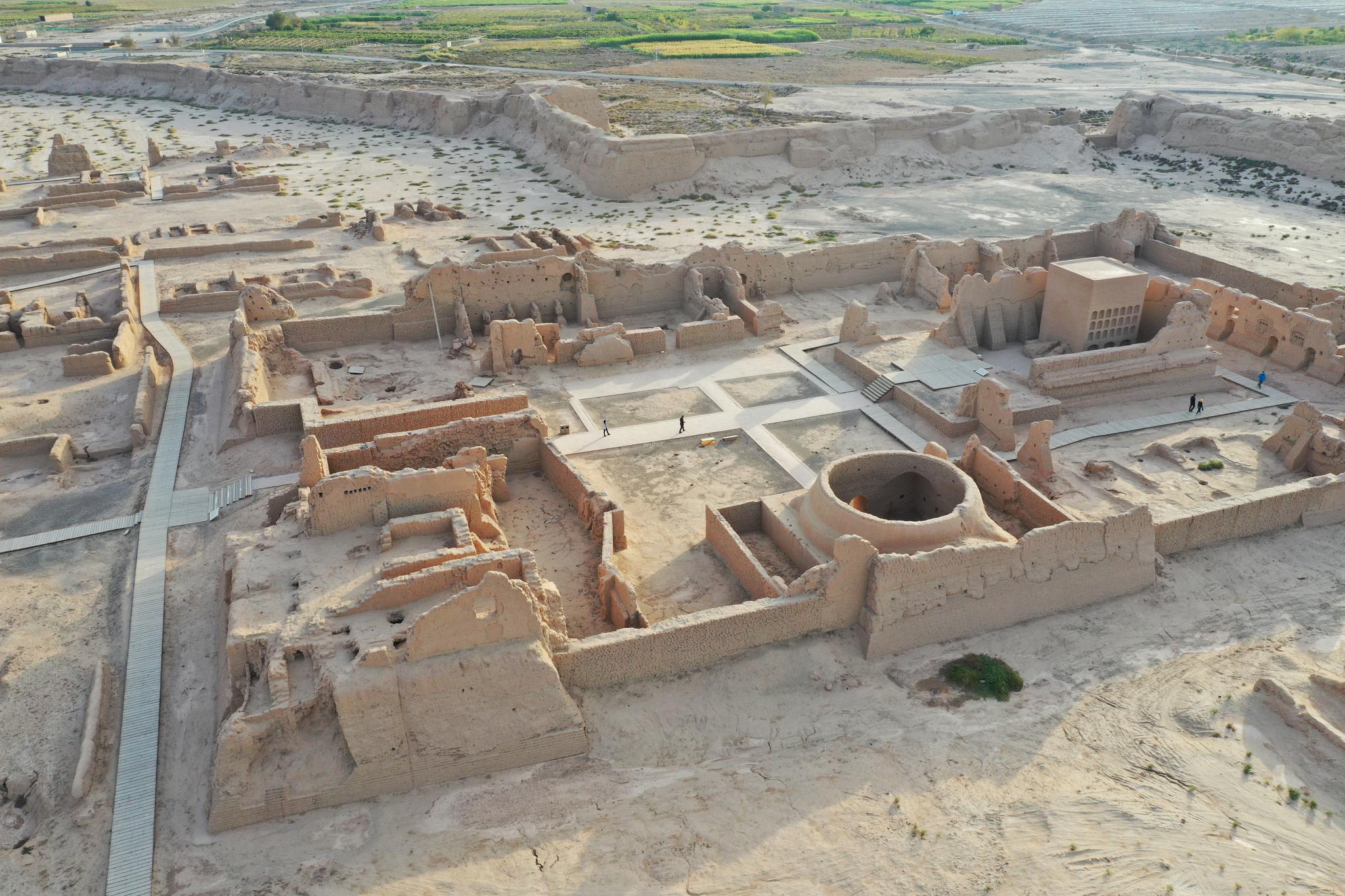
The photo shows the Southwest Grand Buddhist Temple in the Ancient City of Gaochang, Turpan, Xinjiang.
Xinjiang of China, historically known as the Western Regions, is a vast territory where diverse cultures meet. Architectural remnants—city ruins, watchtowers (including beacon towers), temples, and dwellings—often retain identifiable Central Plains stylistic features. Having withstood millennia of weathering, these structures still rise in the oases and deserts north and south of the Tianshan Mountains, quietly bearing witness to the past.
Imprints of Central Plains culture in Western Regions architecture
Ancient Chinese buildings were commonly made from perishable materials, so few survive intact. Many rammed-earth structures now exist only as foundations, and wooden buildings have largely decayed. In Xinjiang, structures of Ming (1368–1644) and Qing (1616–1911) dynasties are comparatively well preserved; earlier buildings usually remain as ruins. Still, elements of Central Plains culture are evident in their layouts and construction details.
In 60 BC, the Western Han Dynasty (206 BC–AD 25) established the Western Regions Protectorate at Wulei City (in present-day Luntai county, Xinjiang), marking the formal incorporation of Xinjiang into China's territory. The ancient city of Zorkut in Luntai county was in use from the Spring and Autumn period (770–476 BC) through the Han Dynasty (202 BC–AD 220). Recent systematic archaeological excavations have produced key evidence identifying the Protectorate site. The city was a vast three-tiered complex: Excavations in the northern section of the inner city's eastern platform revealed a rectangular high-platform city site surrounded by defensive features such as bastions and turrets. The unearthed pottery closely resembles pieces from Chang'an and the Hexi region. The city's plan and defensive arrangements followed Central Plains urban and military conventions, making it a prime example of an early Western Regions city shaped strongly by Central Plains culture.
The Shichengzi Site in Qitai county, identified as the Shule City of the Eastern Han Dynasty (25–220), sits on a steep mountain spur. The nearly square city contained a sub-city in the northwest; defensive features—turrets, projecting ramparts, and a moat—were found near the west gate. Han-style circular roof tiles and wuzhu coins were unearthed. The site's layout adheres closely to Han Dynasty border-garrison military construction standards.
During the Wei, Jin, and Southern and Northern Dynasties (220–589), architectural techniques were also evident underground. A tomb complex from the Sixteen Kingdoms period (304–439) along Youyi Road in Kuche revealed 15 chamber tombs built of blue and red bricks, buried 7-10 meters below the surface in a sand-and-gravel layer. Their construction closely resembles Wei-Jin brick-chamber tombs found around Jiuquan, Jiayuguan, and Dunhuang. Tomb lintels bear carvings of Central Plains mythical creatures such as the Heavenly Deer, Xuanwu (Black Tortoise), White Tiger, and Vermilion Bird.
The Tang Dynasty (618–907) was the period when Chinese city-planning norms reached a mature form. Chang'an, the capital of the Sui (581–618) and Tang dynasties, adopted a square layout with nested palace, imperial, and outer cities, embodying ritual culture and governing philosophy of the Chinese nation. This idea of great unity deeply influenced frontier urban design. For example, Gaochang Ancient City in Turpan was a near-square, tripartite complex—palace city (Khan's Castle), inner city, and outer city—with barbican (wengcheng) ruins outside the west and north gates and well-preserved projecting ramparts, earning it the nickname "a replica of Chang'an."
Numerous beacon towers remain across Xinjiang today. As vital communication and military-defense installations for transmitting intelligence, these towers were sited along the Great Wall to form an early-warning network; in this sense, the Western Regions' beacon towers functioned as a westward extension of the Great Wall. The Central Plains followed a standardized system—typically one beacon every 30 li (approximately 15 kilometers), adjusted for difficult terrain. A complete beacon complex included a beacon mound, garrison quarters, and a sheep-and-horse city (yangmacheng, a defensive structure), with strict protocols for signal fires and smoke. The Western Regions adhered to this system. The Keyakekuduke Beacon Tower in Yuli county, Bazhou (comprising the tower itself and associated residential buildings) conformed to Central Plains layouts. Excavations there have yielded fragmentary texts such as Han Peng Fu, The Classic of Filial Piety, and The Thousand-Character Classic, tangible evidence of Central Plains cultural transmission into the Western Regions.
Though many religious buildings in Xinjiang derive from non-indigenous traditions, they often incorporate pronounced Central Plains elements. At the Subash Buddhist Temple ruins in Kuche, a pavilion-style pagoda closely resembles Tang-era pagodas in the Central Plains—such as the Giant Wild Goose Pagoda at Da Ci'en Temple, the Xuanzang Pagoda at Xingjiao Temple, and Master Dushun's Pagoda at Huayan Temple—all exhibiting pavilion forms that imitate wooden construction. This suggests that Buddhism, after spreading throughout the Central Plains, returned to the Western Regions and influenced local architectural practice. A similar fusion appears in Islamic architecture. The Shaanxi Grand Mosque in Urumqi, built during the reign of Emperor Qianlong (1736–1795) of the Qing Dynasty, skillfully blends Islamic and Chinese classical forms. Its palace-like composition, traditional timber framing, and richly painted beams reflect a clearly Central Plains imperial aesthetic, giving the mosque notable historical, artistic, and visual value.
Why is Central Plains culture so deeply imprinted in the Western Regions?
How did Western Regions architecture retain pronounced Chinese cultural marks despite geographic barriers and historical changes? Three primary reasons explain this persistence.
First, the outstanding inclusiveness of Chinese civilization. Concepts such as "harmony in diversity" and an "all-embracing mindset" are inherent characteristics of Chinese civilization. Whether early cultural exchanges between the Central Plains and grassland areas in the pre-Qin period (before 221 BC) or the proactive absorption of diverse cultures by unified dynasties such as the Han and Tang, they all reflect the Chinese nation's wisdom of upholding the beauty of each civilization and the diversity of civilizations in the world. This inclusive approach ensured that Central Plains architectural culture was not unilaterally exported but rather harmoniously blended with the local natural environment, construction techniques, and aesthetic preferences of the Western Regions, resulting in a unique fusion style of the Central Plains architecture and local architecture.
Second, sustained, effective governance by central dynasties. From the Western Han's establishment of the Western Regions Protectorate onward, successive central governments maintained long-term control through official administrations, military garrisons and land reclamation, fortification building, and the upkeep of transportation networks. That governance extended beyond government decrees and defense to cultural influence. Official architecture, urban-planning principles, and military defensive systems in the Western Regions generally followed Central Plains models.
Third, the crystallization of sustained exchange and interaction among ethnic groups. The Western Regions had long been a multiethnic hub, home to Han, Xiongnu, Qiang, Sogdian, Turkic, Uygur (Uighur), and Mongolian peoples whose migrations and interactions formed an interwoven cultural ecosystem. Central Plains artisans brought advanced rammed-earth and timber-framing techniques, while local craftsmen contributed regional materials and specialized know-how. Trade caravans enabled the flow of building materials, and religious transmission encouraged reciprocal borrowing of forms. Centuries of interaction and fusion embedded elements of Central Plains culture deeply within the fabric of Western Regions architecture.
The exchange of building techniques was not a simple transfer of methods but a cultural dialogue enacted in material space, with effects that penetrated spiritual life and social practice.
When visitors walk among the ruins of the Daming Palace in Xi'an and the ramparts of Gaochang, touch the Great Wall's massiveness and the solidity of the Kizilgaha Beacon Tower, or enter the carved and painted interiors of Beijing's Yonghe Lama Temple and Urumqi's Shaanxi Grand Mosque, they can sense a remarkable consistency in structural logic and construction craft between the Western Regions and the Central Plains. This spatial sense of familiarity shows that the Western Regions were not isolated from Chinese civilization but shared common cultural roots with the Central Plains.
The relationship between the Western Regions and the Central Plains: An architectural-history perspective
The unmistakable Central Plains architectural forms in the Western Regions demonstrate that the region was never a "foreign land" but has long been knitted to the Central Plains, sharing weal and woe, and Xinjiang is an inalienable part of China.
From the Western Regions Protectorate of the Western Han Dynasty, through the Anxi and Beiting Protectorates of the Tang Dynasty, to the Yili General's Mansion of the Qing Dynasty, successive central dynasties treated the Western Regions as integral territory, exercising governance via establishing administrations, dispatching officials, and promoting institutional measures. That governance appears not only in documents and military garrisons but also in urban planning and building regulations. The Central Plains architectural paradigm in the Western Regions is, essentially, a spatial expression of state authority, attesting that the Western Regions have been an integral part of China since ancient times.
Beneath the exchange of building techniques lay an organic fusion of the Central Plains cosmology of "harmony between heaven and humanity," the social order grounded in ritual propriety, and the indigenous cultures of the Western Regions. Whether in Gaochang Ancient City's emulation of Chang'an's urban planning or in the incorporation of dougong (bracket sets) and feiyan (overhanging eaves) into local Islamic architecture, these instances embody a central Chinese cultural ethos of harmonious coexistence. Peoples of diverse ethnic groups across the Western Regions shared traditional Chinese values, forging a spiritual bond that transcended geography.
Over the past two millennia, military and civilian settlers for reclamation and defense, silk merchants, and Buddhist monks from the Central Plains — alongside caravans, musicians, and painters of the Western Regions — traversed oases and deserts. Through daily life and labor, these interactions fostered a tight-knit community among diverse ethnic groups. The blending of architectural techniques was but one facet of this extensive and profound cultural exchange.
The views don't necessarily reflect those of DeepChina.
The author is Wang Yuping, associate professor at the Research Base for Forging a Strong Sense of Community for the Chinese Nation, Xinjiang University.
Editor/ Kang Mengting



























 京公网安备 11010202009201号