



By He Shaoqing and He Jing
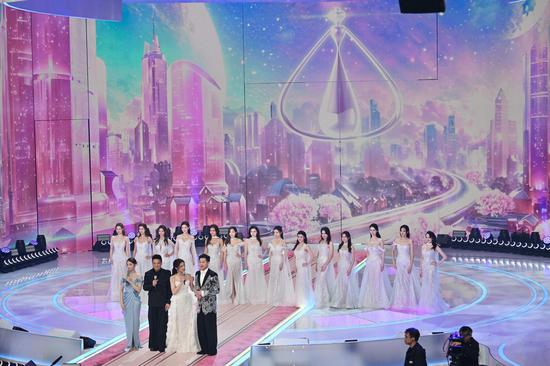
(CNS Chengdu) -- With the theme “A Date with Light and Shadow, Embracing Beauty,” the second Golden Panda Awards took place in Chengdu on September 12–13. This year’s competition attracted 5,343 submissions from 126 countries and regions, including 3,910 works from overseas, making up 73.2% of the entries.
What sets the Golden Panda Awards apart from the thousands of film festivals and prizes around the world? How can cinema foster dialogue among civilizations? And what kinds of films can elicit empathy across Eastern and Western audiences? Hussein Fahmy, president of the Cairo International Film Festival and a guest at the Golden Panda Awards, shared his insights in an exclusive interview with China News Service’s “East-West” program.
CNS: There are countless film festivals and awards globally. What makes the Golden Panda Awards different?
Fahmy: First, we need to recognize that cinema is a vivid reflection of culture. The magic of film lies in its ability to let us step into the world of its characters—to experience their situations, their joys, and their sorrows.
Whether you are making a film or watching one, it is always a cultural experience. Unlike festivals that focus heavily on the latest industrial technologies, the Golden Panda Awards emphasize dialogue between different cultures.
During the event, we see films from many countries and regions, across genres and traditions. Through this wonderful window, we learn about other societies, broaden our perspectives, and deepen our understanding of humanity itself.
Of course, commercial blockbusters dominate the market because they generate profits. But we also need non-commercial cultural exchanges in cinema. I have loved films since I was eight years old, dreaming of devoting my life to the medium. The Golden Panda Awards create precisely this opportunity for cinephiles like me.
The award’s name, too, carries special meaning. The giant panda symbolizes warmth and approachability, which makes me all the more eager to participate in the event and follow its growth.
CNS: How can films and film festivals enhance cultural exchange between Egypt and China?
Fahmy: Egypt and China may have different development paths, but both have rich histories and civilizations. In cinema, our two countries can cooperate in many ways—co-productions, distribution, or the adoption of new technologies.
Today, language is no longer a barrier. Subtitles help, of course, but even without understanding a single Chinese character, I can laugh, cry, and feel peace while watching Chinese films. Images themselves are a universal language, often richer than words.
I helped establish cooperation between the Cairo International Film Festival and the Shanghai International Film Festival. We send delegations to Shanghai to learn from their experience, and in turn, we host Chinese guests in Cairo.
The results have been fruitful. Cairo has hosted “Chinese Film Weeks,” allowing Egyptian audiences to engage with Chinese culture. Likewise, Beijing, Shanghai, or other Chinese cities could hold “Egyptian Film Weeks.” Such exchanges build mutual understanding.
Chinese films have long been part of the Cairo festival. They are very popular in Africa, thanks to translation and subtitles. The success of Chinese cinema stems from the industry’s rapid progress in recent years—it is gaining more and more international viewers.
CNS: Many festivals showcase classic films. What can we learn from them?
Fahmy: I am currently working on restoring Egypt’s old films, including black-and-white ones from the 1940s and 1950s. While the original audiences may no longer be alive, new generations are curious about that era and its cinematic language.
We keep the black-and-white aesthetic and simply add subtitles. I see this as a vital mission. Our company has collected hundreds of such films, and we have already restored more than 20, which are screened during the Cairo festival. Film history and the future are equally important.
CNS: What kind of films resonate with audiences both in the East and West?
Fahmy: There is no clear formula. What matters is the filmmaker’s sense of responsibility to create meaningful content, and the courage to keep exploring.
Ultimately, audiences decide a film’s fate, and social or political environments also play a role. Sometimes a carefully crafted film succeeds brilliantly, sometimes it falls short—you cannot always explain why. Success depends on timing, circumstances, and collective response.
Even if a film goes unrecognized at first, audiences may rediscover its value years later. For filmmakers, the key is to approach every project with the determination to make it the best it can be.
Cinema is never a solitary art. The relationship between filmmakers and audiences is like a thrilling ping-pong match—we cannot create in isolation. In earlier days, audiences immersed themselves fully in theaters, laughing and weeping as if they were inside the story. Vendors even sold tissues outside cinemas because viewers often left with tear-streaked faces.
Today, some films rely on dazzling effects and gravity-defying scenes. But if technology is used merely as spectacle, without emotional depth, such works struggle to connect across cultures.
What truly resonates are films with characters audiences can relate to, characters whose lives they feel they have lived. You enter the theater and live through a story; when you leave, the film still lingers, sparking conversations with others. That lasting impact is the essence of cinema.






































 京公网安备 11010202009201号