



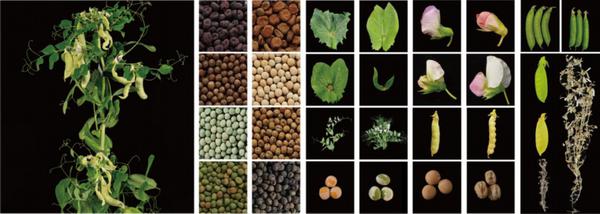
Phenotypic diversity in the seven traits of pea plants. (Photo provided to China Daily)
A team of international scientists, mainly from China and the United Kingdom, has jointly identified the genetic variants behind all seven traits used by Gregor Mendel more than 160 years ago to discover the basic laws of inheritance, solving a long-standing mystery in biology. The findings were published this week in the journal Nature.
The study, titled Genomic and genetic insights into Mendel's pea genes, was led by Cheng Shifeng, a professor of the Agricultural Genomics Institute at Shenzhen, Chinese Academy of Agricultural Sciences, alongside Noam Chayut and Noel Ellis, who are professors at the UK-based John Innes Centre.
By combining modern genomics, high-throughput phenotyping, and computational biology, the team revisited Mendel's landmark 1865 experiments with garden peas.
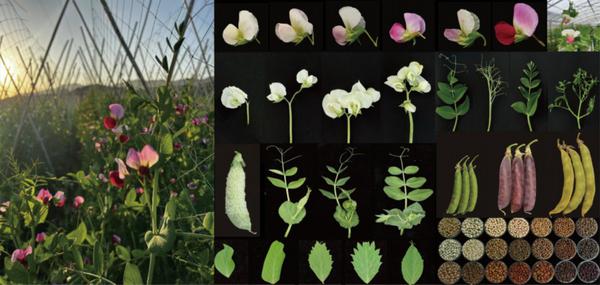
A wide range of pea phenotypes are cultivated at the Shenzhen Germplasm Resource Nursery. (Photo provided to China Daily)
Mendel's work led to the discovery of genetic inheritance and the laws of segregation and independent assortment. While most of the genes behind his seven trait pairs — such as round vs wrinkled seeds and tall vs short plants — had been found in recent decades, three remained unidentified until now.
A key part of the project involved building a broad and genetically diverse panel of pea accessions. Chayut, head of the germplasm resources group at the John Innes Centre, worked with Ellis, a long-time pea genetics expert, to select more than 700 samples from the institute's Pisum collection.
"To find rare variants, a broad and representative sampling was essential," said Chayut.
These accessions were introduced into China after 2019 and grown in both southern and northern regions. Cheng and his team then conducted detailed trait analysis and built a high-resolution genetic variation map, which led to the identification of the previously unknown genetic variants.
"Mendel discovered what we now call the laws of inheritance without knowing what a gene was," said Cheng. "Today, using modern tools, we can see the exact genes — and the precise mutations — that he unknowingly tracked."
Researchers also analyzed more than 70 additional agronomic traits and linked them to thousands of genetic markers.
The resulting genomic resources could help breeders use AI-powered predictive models to accelerate the development of improved pea varieties and introduce useful genetic traits from wild and traditional strains, Cheng said.












































 京公网安备 11010202009201号