



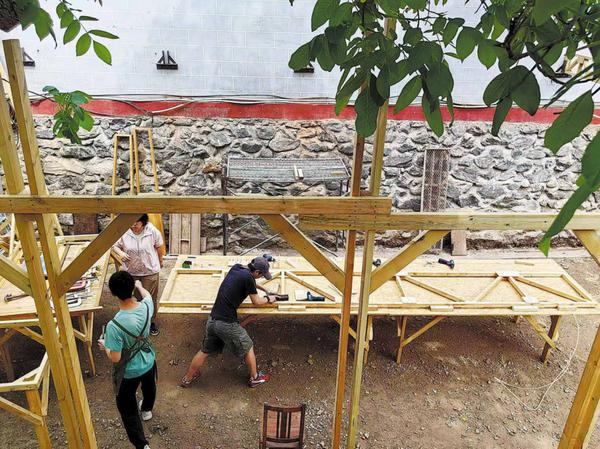
Hu works with professional carpenters to build a wooden pavilion in Miyun last year. (CHINA DAILY)
Building skills
Wu Xiaoyu, from Hefei, Anhui province, has attracted more than 300,000 followers on social media platforms since she started sharing her craft projects about five years ago. Wu describes herself as being an ordinary office worker back then, ordering takeout most nights and watching videos about minimalism and sustainable living.
Her first DIY inspiration came from an unlikely source: discarded milk tea bags. "It was such a nice material — thick, waterproof. I couldn't bear to throw it away," Wu recalled.
Wu cleaned one bag and stitched it into a small pouch for storing cables. That small act of reuse led to more experiments, including turning empty beer bottles into vases, crafting storage bins from food packaging, and even making candles in repurposed glass jars.
She then started sharing these small projects online. To her surprise, her tutorials struck a chord with viewers.
"People would message me saying, 'I want to do this too, but I don't know how to start'. That's when I realized there's this quiet yearning in many of us to create with our hands," she said.
Wu took her hobby up a notch after she bought her own apartment and faced a dilemma. The developer's decor felt cold and generic, and design companies' quotes for customization work were astronomical.
"Either I had to accept a space that didn't reflect me, or tear it all out and start fresh," she said.
"I wanted a home that felt like me, not something copied out of a catalog. So I decided to make it with my own hands."
Wu began frequenting hardware stores and construction sites, peppering carpenters and experts with questions about tools and techniques. She signed up for woodworking workshops, learned to operate power tools and watched hours of online tutorials about joinery.
Her first major project — a dining table — took her three months of trial and error to build.
"I remember staring at the planks of wood and thinking, 'what am I doing?'" she said. "But once I assembled it and sat down to eat my first meal on it, it felt like a victory."
However, not everything went smoothly. Early on, she mismeasured a set of cabinet doors, leaving a half-inch gap that annoyed her every time she saw it. "I kept it that way for a while to remind myself that precision is everything," Wu said.
Then she discovered aluminum profiles — modular, lightweight metal beams often used in industrial furniture. They became her secret weapon. "It's like Lego for adults. You can create frames for tables, shelves, or cabinets and customize dimensions exactly," she said.
With each project, her confidence grew.
Now, her apartment looks like it was curated by a high-end interior design studio, characterized by sleek wooden furniture, clean lines, and warm, earthy tones that evoke calm.
A handcrafted walnut cabinet sits perfectly flush with the wall, and a sturdy dining table anchors the open-plan living space. They are among countless details that were designed, cut and assembled by Wu herself.
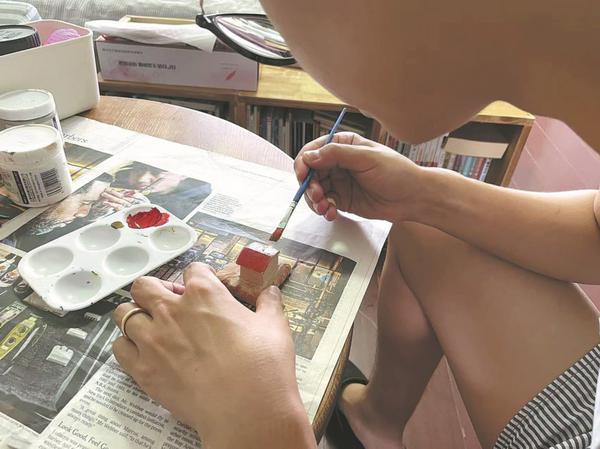
Hu paints a component of a wooden sculpture gift to a friend. CHINA DAILY
Test of patience
Like Wu, Hu Jie also had no formal training.
He studied business management at university, cycled through jobs in sales, auditing, finance and platform operations before landing in consulting.
His closest brush with craftsmanship had been assembling Ikea furniture.
Hu's early attempts at making furniture were not without challenges. Using a low-powered electric screwdriver given to him by a friend, Hu found assembling sturdier furniture to be laborious and time-consuming.
"Every evening after work, I'd spend hours drilling and sanding. The noise worried me. I didn't want to disturb the neighbors, but I pushed on," he said.
Dust, fatigue and the sheer effort often left him questioning if it was worth it.
"But when the pieces finally came together, and I saw them in our home, the satisfaction outweighed the exhaustion," he said.
Over time, Hu's skills evolved. Initially relying on online tutorials for guidance, he later enrolled in a woodworking class at a neighborhood workshop. There, he learned to use professional tools and experimented with various joinery techniques like mortise and tenon, a traditional Chinese method.
"It's a craft of patience," he said, recalling hours spent sanding surfaces smooth with progressively finer grit sandpapers and finishing them with eco-friendly wood oils.
Hu even joined a volunteer project in northeastern Beijing's Miyun district, helping build a wooden pavilion with a local woodworking studio, where he learned how to use professional tools. This experience enabled him to build a bathroom vanity, balcony storage and a living-room console out of wood panels.










































 京公网安备 11010202009201号