



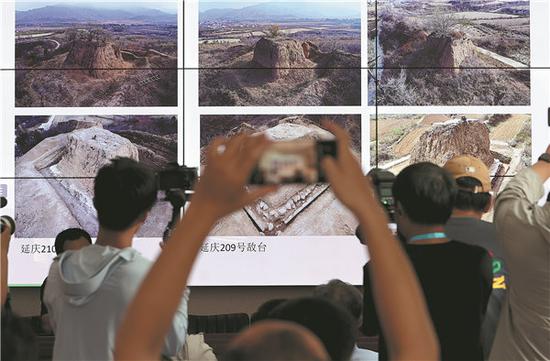
Highlighting the research-based restoration of the Great Wall, a seminar was held in Beijing's Huairou district on Friday. (Photo by Zou Hong/China Daily)
Hebei boasts the Great Wall in different periods, such as those from the Qin (221-206 BC), Han (206 BC-AD 220) and Ming dynasties.
A total of 24 beacon towers on the Fenshuiling section of the Great Wall in Chongli county of the province have been recently studied, and 21 of them didn't reveal Han Dynasty pottery shards (two of them have already been destroyed), Han says.
"The other three beacon towers where Han Dynasty pottery shards were found are relatively low and lack surrounding trenches, while those without Han Dynasty pottery shards are relatively tall and typically have surrounding trenches, which are characteristic of Ming Dynasty beacon towers," Han explains.
Based on the coexistence of artifacts from both the Han and Ming dynasties, it can be inferred that this section of the Great Wall was initially built during the Han Dynasty and later renovated and utilized during the Ming Dynasty, he adds.
"The Han Dynasty beacon towers were either reinforced with additional stones or newly built upon, with surrounding trenches added during the Ming Dynasty renovations," he says.
At the same time, the sections from the Northern Qi Dynasty (550-577) were found in the Haigang district of the province's Qinhuangdao, and continuously arranged beacon towers from the Han Dynasty were uncovered in Chongli.
Han believes the findings will be conducive to the scientific management, protection and research of the Great Wall, enriching its significance and deepening the understanding of it.
Li Yipi, a researcher from the Henan Provincial Institute of Cultural Heritage and Archaeology, expounds on the characteristics and value of the Great Wall of Chu, a vassal state to the Western Zhou Dynasty (c. 11th century-771 BC) dating back more than 2,000 years.
"According to the archaeological excavation findings, the earliest artifacts unearthed within the Chu Great Wall remains date back to the mid-Spring and Autumn Period (770-476 BC)," Li says.
To date, the Chu Great Wall, as recognized by the National Cultural Heritage Administration, is mainly distributed in Pingdingshan, Nanyang and Zhumadian in Henan province. It extends for 383 km and comprises various elements, including artificially constructed long walls, passes, beacon towers, barracks sites and ancient roads, as well as natural mountain passes and rivers, forming an organically unified defensive line.
The Chu Great Wall is also the southernmost of the early Great Wall found so far and its unique geographical location and regional climate have led to distinctive architectural features.
"Archaeological discoveries have shown that at the base of the Chu Great Wall's man-made wall, there are large-scale accumulations of charred wooden sticks or charred wooden sticks mixed with stones. These charred sticks were man-made through firing and had drying properties that prevented dampness and moisture," Li says.
Other experts at the Beijing seminar shared studies of a large number of statues and architectural remains unearthed from Shaanxi that proved cultural exchange on both sides of the Great Wall during the Ming Dynasty, as well as those of relics of Tang Dynasty (618-907) frontier soldiers in Xinjiang, proving the Tang Dynasty's effective governance.
At the seminar, Song Xinchao, chair of the Chinese National Committee for the International Council on Monuments and Sites, called on related parties to further enhance the protection of the Great Wall, strengthen the exploration of its overall value, and further standardize archaeological operations.
"By streamlining the current work processes and taking the construction of the Great Wall National Cultural Park as an opportunity, we aim to comprehensively improve the level of protection and inheritance," Song says.
Tang Yuyang, a professor from the Beijing University of Civil Engineering and Architecture, emphasizes the evolution of Great Wall protection strategies, advocating for a shift toward research-driven restoration and proactive preventive measures, building upon the valuable practical experience garnered in Beijing.
































 京公网安备 11010202009201号