



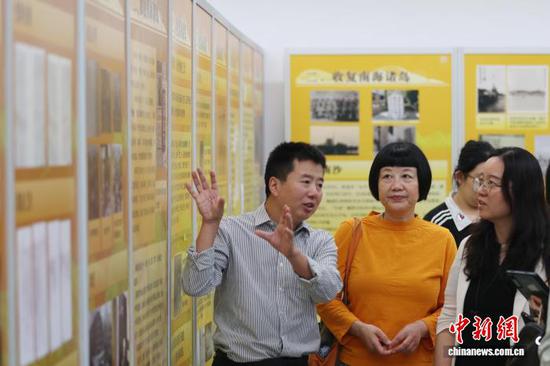
(ECNS) -- An exhibition commemorating the recovery of Taiwan and the Nanhai Zhudao (South China Sea islands), from Japanese occupation opened on Monday at Nanjing University in eastern China, in Jiangsu Province.
The exhibition forms part of a series of events marking the 80th anniversary of the victory in the Chinese People's War of Resistance Against Japanese Aggression and the World Anti-Fascist War.
Nanjing University's extensive collection of documents, historical archives, and visual materials, the exhibition is divided into five sections. It showcases the upheaval of late Qing Dynasty (1644-1911) and the process of resuming sovereignty over Taiwan and Nanhai Zhudao after World War II, featuring 120 display panels, 645 images and charts, over 70 maps, and more than 120 relevant publications.
The exhibition retraces the history of the two regions, including the fact that China's Qing Dynasty government ceded Taiwan to Japan under the unequal Treaty of Shimonoseki in 1895. It highlights the recovery of Taiwan and restoration of the South China Sea islands in line with the Cairo Declaration and Potsdam Proclamation. It also portrays China's vision in the new era of fostering a maritime community with a shared future among neighboring countries.
Beyond conventional displays, the exhibition features specialized sections on maritime culture, historical maps, and Geng Lu Bu (ancient sea route manuals). It also incorporates Augmented Reality (AR) technology to offer immersive experiences of the South China Sea's historical and cultural heritage.
The core value of the exhibition lies not only in demonstrating China's historical proposition and legal basis on the South China Sea issue and Taiwan question but also in helping teachers and students understand history and draw spiritual strength, said Zhu Feng, executive director of Nanjing University's Collaborative Innovation Center of South China Sea Studies.
"Only by clearly understanding the humiliations and struggles of the past can we more profoundly grasp the importance of safeguarding national sovereignty, which serves as the foundation for facing the future and building lasting peace," he added.
(By Zhang Dongfang)


















 京公网安备 11010202009201号