




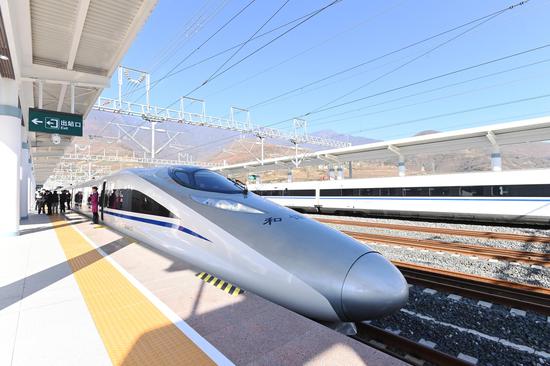
The newly built Karawang Station is located in West Java, Indonesia. (LIU YUCAI/FOR CHINA DAILY)
Training local talent
Considered a synergy between the BRI and Indonesia's Global Maritime Fulcrum strategy, the railway project also required recruiting and training local construction engineers and workers. When Chen became the chief economist of CREC4's project management department, he was told of its firm vision of cultivating local talent to help build the HSR.
During the construction period, CREC4 continued to increase training for Indonesian employees, assisting the host country in building its own HSR construction staff.
With the practical principle of "a Chinese tutor an Indonesian apprentice", CREC4 builders helped cultivate nearly 10,000 high-speed railway construction technicians for the host side, Chen said.
Adhering to the concept of mutual consultation, construction and sharing, CREC4 builders put great emphasis on sharing their experiences with the Indonesian side, said Han Xinliang, publicity chief of CREC4 First Engineering Co Ltd.
"At CREC4, I have access to advanced Chinese engineering techniques," said Indonesian employee Aldy Raynaldo, adding that "with the Jakarta-Bandung HSR, I believe that Indonesia's infrastructure can be further elevated".
Chen and other Chinese management staff offered the Indonesian workers face-to-face assistance during daytime hours, and at night the Indonesians received training in technical and labor management, data preparation, work acceptance, pricing and document collection. As a result, five local employees gained promotions and 19 others took up engineering and technical positions in Chen's project management department. In total, CREC4 hired over 3,000 local people to work on its project.
A bond between minds
The HSR project facilitates understanding between the Chinese and Indonesian peoples, said Li Jinpeng, a staffer from the No 4 beam fabrication yard of CREC4.
"In the beginning, I was unfamiliar and restrained with my Indonesian colleagues, but with the increase in communications, we came to understand and support each other, and I could feel our friendship blossoming," said Li.
During the construction period, though the work schedule was tight, the CREC4 project management department organized basketball or badminton competitions during holidays and festivals in an effort to ease homesickness and offer a chance for Indonesian employees to experience Chinese culture.
"Although we come from different countries and have different cultures, I feel particularly happy to spend holidays together like family members," said Marissa, an interpreter at the No 2 division of CREC4 project management department. "To ensure the smooth progress of the HSR, many of our Chinese colleagues were unable to return home for family reunions. They have a strong sense of responsibility, and I appreciate them very much and thank them very much."
Randi Ramdhani, an Indonesian technician from the CREC4 No 4 beam fabrication yard, said he is extremely thankful for China's help in building the HSR in Indonesia, which is bringing great changes to his hometown.
Liu Bo, Party secretary and chairman of CREC4, attended the official launch of the Jakarta-Bandung HSR, feeling proud of his colleagues' contribution to the railway. During his visit on May 14 to Jakarta-Bandung HSR, Han Yonggang, general manager of CREC4, called on his colleagues to strive to make it a strategic pillar and model project for coordinating CREC4's overseas operations.
CREC4 was founded in November 1950 and now has 23,360 employees. In addition to its mammoth domestic operations, the company has ventured into Angola, Ethiopia, Mongolia, Indonesia, Bangladesh, Costa Rica and a dozen other countries.





























 京公网安备 11010202009201号