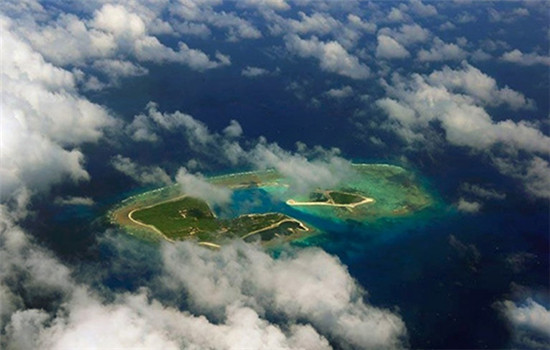
File photo of South China Sea. (Photo/Xinhua)
Editor's Note: The following article is an abstract from a report by the National Institute for South China Sea Studies, headquartered in Haikou, capital of South China's Hainan province.
The United States' military deployments and activities in the Asia-Pacific region are important manifestations of its "rebalancing" strategy. Since President Barack Obama took office in 2009, the U.S. global military strategy has been shifting its focus and giving priority to the region. In 2012 and 2013, it officially announced that 60 percent of its naval vessels and 60 percent of its air force would be deployed in the Asia-Pacific region by 2020. Driven by this rebalancing toward the Asia-Pacific, the U.S. has gradually built up its troop deployments, forward presence and military activities in the region, and increased military cooperation with its regional allies and partners, such as Japan and Singapore.
I Military expenditures, bases and deployment
The proposed U.S. defense budget for fiscal year 2016 was $585.3 billion, an increase of about 4 percent on the budget for the previous fiscal year. In February 2016, the U.S. Department of Defense released a proposed budget request of $583 billion for fiscal year 2017, which is almost the same as that for the previous fiscal year.
By 2015, the U.S. had 368,000 military personnel in the Asia-Pacific region, among whom about 97,000 are stationed to the west of the International Date Line. The military personnel deployed in the Asia-Pacific region account for more than 50 percent of its total military forces overseas.
II Military activities
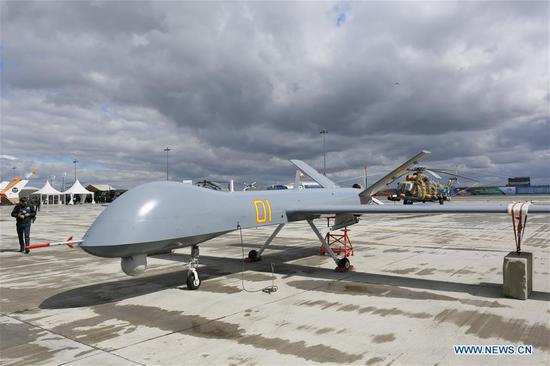
With the implementation of its rebalancing to the Asia-Pacific strategy, the U.S. has deployed advanced reconnaissance aircraft, unmanned aerial vehicles, electronic surveillance ships, nuclear submarines, orbit reconnaissance satellites, etc. China has become the No 1 target for the U.S.' close reconnaissance in terms of frequency, scope and means. According to available statistics, the U.S. made more than 260 close reconnaissance sorties against China in 2009. The number was more than 1,200 in 2014, and there was an obvious increase in U.S.' close reconnaissance activities in the South China Sea region in 2015. Such activities threaten China's national security, damage China's maritime rights and interests and undermine Sino-U.S. strategic mutual trust. They could also lead to accidental collisions at sea or in the air, making such reconnaissance an important negative factor affecting Sino-U.S. relations and also peace and stability in the region.
Regarding naval operations, more than 700 patrols were conducted by U.S. vessels and aircraft in the South China Sea region in 2015. It is noteworthy that recent U.S. patrols in the South China Sea have been accompanied by a lot of media hype and high-profile assertions they are freedom of navigation operations, a phenomenon not seen anywhere else.
The U.S. has also raised the frequency, scale and complexity of its joint military exercises in the Asia-Pacific region. In 2014, U.S. Pacific Command initiated 160 bilateral and multilateral military exercises in the region. The number of military exercises rose to 175 in 2015. In recent years, the content of the joint exercises has expanded and they now include ground warfare, aerial warfare, maritime warfare, anti-missile warfare, and special operations, as well as electronic and cyber warfare.