Rare-disease patients face uphill struggle
2018-08-24 09:45:00 China Daily Mo Hong'e
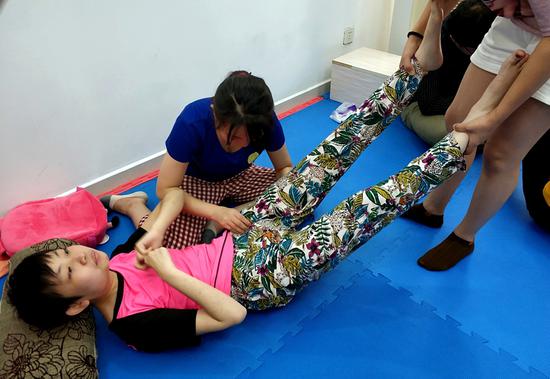
Rett syndrome patient Sze Ka-yan receives mobility therapy. (Photo/China Daily)
Slow approvals and stratospheric costs can keep effective drugs out of reach in Hong Kong.
Experts are putting pressure on the government of the Hong Kong Special Administrative Region to allow speedy approval of medications that could keep about 7,500 people in the city with rare diseases alive.
The box office hit Dying to Survive, which opened in cinemas on the Chinese mainland last month, helped put the issue of accessibility to medicine and treatment for patients with rare diseases back on the table. The film is based on the true story of a Chinese patient with chronic granulocytic leukemia who smuggled cheap cancer medicine from India for 1,000 other people with the disease, which is linked to a genetic abnormality.
Patients in Hong Kong with rare diseases who are desperate for effective drugs either find none are available in the city or that those on the market are exorbitantly expensive. Many choose to discreetly buy cheap, generic alternatives from elsewhere.
Helen Tsui's 24-year-old daughter, Sze Ka-yan, has Rett syndrome, an incurable, debilitating brain disorder caused by a genetic mutation. It affects about one in 8,500 females worldwide, with patients losing their motor and communication skills.
Tsui said she had heard that patients in Hong Kong with this disease had tried to smuggle cheap drugs from India to slow its development.
"A drug called IGF-1 has proved effective for Rett disease and is available in local pharmacies," she said. "But patients have to take a big dose, about two bottles a day, with each bottle costing HK$400($51).
"I knew some patients brought a replica from India, a small dose of which is said to have a similar effect to the daily intake of Hong Kong's version."
Terry Lai, business development officer for the Hong Kong Alliance of Rare Diseases, said, "It takes eight to 12 months to register an FDA-approved drug in Hong Kong and sometimes years after that for it to be included in the Hospital Authority's drug formulary." The FDA is the United States Food and Drug Administration, and the formulary is a list of drugs subsidized by the Hong Kong government.
The Hospital Authority's Drug Formulary Committee meets every three months to consider which new drugs to add to the formulary. Priority is given to drugs that would benefit large groups of people, such as those with cardiovascular diseases.
"(People with) rare diseases are at a disadvantage," Lai said. "Rare diseases affect few people and the drugs that may treat them aren't cost-effective."
He said that while a rare disease is officially defined in many countries and regions, there's no precise definition in Hong Kong. The US started adopting a definition in 1983 that described a rare disease as a condition affecting fewer than 200,000 people. Japan introduced its own definition in 1993, Taiwan in 2000, South Korea in 2003, and the Philippines in 2016.
Early treatment
Danny Chan, assistant dean of the Li Ka Shing Faculty of Medicine at the University of Hong Kong, said patients with rare diseases often deteriorate quickly and early treatment is essential.
One example is tuberous sclerosis complex (TSC), a genetic disorder causing tumors in soft organs that result in seizures, intellectual disability, and lung and kidney diseases.
Rebecca Yuen's daughter, Lam Chuk-yiu, was diagnosed with TSC 20 years ago and is among about 200 people with the disease in Hong Kong.
Lam began having seizures when she was 5 months old. They became more frequent, going from once a day to 160 times a month.
"Her whole body would jerk and shake violently," Yuen said. "Suddenly she would fall into a trance. I could do nothing but hold her up and massage her. It was heart-rending to see my little girl crying and in such pain."
In 2010, Yuen learned about the use of mTOR inhibitors, drugs that inhibit tumor development, in the US and Europe to treat TSC.
"It is said that if patients take the medicine from an early age, they will likely be nearly normal when they reach adulthood," she said.
Yuen and the families of other TSC patients put pressure on lawmakers to approve the drug, but encountered opposition.
"The medicine is expensive, HK$20,000 per month, per patient," Yuen said. "There are only a handful of TSC patients in the city, so maybe it's not cost-effective to import it. But life can't be measured in money."
She founded the TSC Association of Hong Kong in 2015 and is its president. The Legislative Council took notice of their cause when a single mother died of TSC in April last year, leaving a 13-year-old daughter, who had inherited the disease.
The mother's death underlined the serious consequences of TSC, and the government added mTOR inhibitors to the formulary after local organizations protested outside the government headquarters.
But Yuen's daughter does not qualify for a drug subsidy, in part because her tumors are too small, and Yuen's hopes faded.
Her daughter is in her 20s, well past the prime age for treatment. This year, Yuen led the mothers of other TSC patients to approach Swiss pharmaceutical company Novartis, which agreed to a two-year program to collect evidence of mTOR inhibitors' effectiveness, and then submit a report to the government. The company will underwrite 75 percent of the cost of mTOR inhibitors to 30 selected Hong Kong patients under 18.
"When my daughter was young, there were no effective drugs, so we missed out on the prime time for treatment," Yuen said.
Now that potentially useful drugs are available, she said that as association president she would "spare no efforts helping other younger patients so that they won't experience the misery that we did".
Brain surgery in the US that cost the family $80,000 successfully removed the tumors on Lam's left cerebral hemisphere. Her seizures became less violent and less frequent, but the surgery was unable to remove all her tumors.
Lai, from the Hong Kong Alliance for Rare Diseases, has Pompe disease, a malady caused by mutations in the gene responsible for producing the enzyme that breaks complex sugars into simple glucose. Excessive sugars accumulate in muscles, organs and tissues, making it difficult for patients to walk or even breathe. Pompe afflicts only one person in 40,000 worldwide.
Lai and his elder brother are among about 20 Hong Kong patients. They began seeking medication when they were first diagnosed in their teens, but their efforts inevitably met with a soul-destroying shake of the head from medical experts.
In 2010, his brother had only 10 percent of a healthy person's lung function and was certified as critically ill and put on life-support. Then Lai learned online about a drug called Myozyme, that had been prescribed in the US and Taiwan since 2006. Lai printed out the prescription and wrote a plea to his doctor asking that Myozyme be considered. His doctor learned the medication was already available in Hong Kong, but only for infants.
Lai lobbied the Hospital Authority's Expert Panel on Rare Metabolic Diseases, pleading that adults with the disease be given a Myozyme subsidy. In 2011, Lai's brother was given subsidy approval and survived - nearly five years after Myozyme was approved in the US.
"I am fairly lucky, compared with most rare-disease patients in the city who live without hope," Lai said.
Urgent need
He said he knows of four types of drugs widely used elsewhere to treat Fabry disease, a rare, lethal malady arising from a deficiency of an enzyme that digests a type of fat.
Accumulated fatty molecules affect the function of the skin, eyes, gastrointestinal system, kidneys, heart, brain and nervous system. However, no drug is approved for use in Hong Kong.
Chan said that while patient safety must take priority, the authority should also weigh the urgency of need when considering treatment for rare diseases.
Sze, who has lived with Rett syndrome for 24 years, now has the intellectual capacity of a 2-year-old and has almost lost her ability to speak.
"I suspected something was not right when she was 3," Tsui said. She said her daughter became quiet, called her "sister" or "brother", fiddled with her fingers involuntarily and barely spoke, muttering only single words at times.
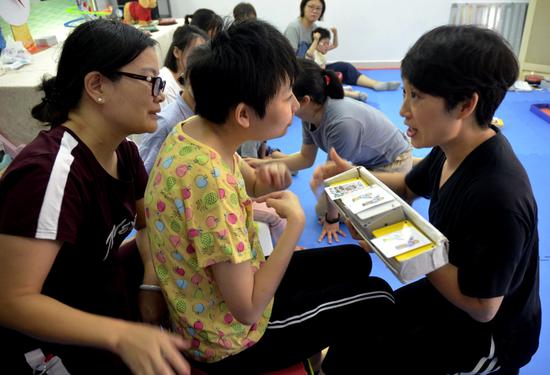
Sze Ka-yan, who has the intellectual capacity of a 2-year-old, receives regular cognitive therapy. China Daily
Tsui took her daughter to the doctor. Tests led her nowhere and she was referred to a specialist. After another year, Sze's condition was diagnosed. By the time she started primary school, Sze had already lost basic abilities.
"She couldn't feed herself," Tsui said. "Her wasted mastication muscle didn't allow her to chew food properly. School caregivers had to cut food into small pieces and put them in her mouth."
Chan said it took 10 to 20 years to understand the mechanism of a disease, and then five to 10 years to develop and test a drug.
In March, a 23-year-old spinal muscular atrophy (SMA) patient managed to persuade the Hong Kong government to import an effective drug, Nusinersen, after writing a letter to city Chief Executive Carrie Lam Cheng Yuet-ngor.
SMA is a rare neuromuscular disorder resulting in progressive muscle wasting, loss of motor skills and early death. Nusinersen is made in the US and had been approved by the FDA, but it had not been registered in the city. Now SMA patients in Hong Kong can access the drug free of charge.
Chan said Hong Kong is short of expertise in dealing with rare diseases, with only a few clinical geneticists specializing in rare conditions among children.
But universities in Hong Kong are building up the pool of clinical geneticists. The Chinese University of Hong Kong has collaborated with Baylor College of Medicine from the US on a geneticist training program since 2012.
Edwin Chan, associate vice-president at CUHK's School of Life Sciences, who has studied neurological disorders and developed therapeutic interventions for 20 years, said local medical schools and hospitals should introduce geneticist training programs from overseas to equip more physicians with knowledge of rare diseases.