NGOs developed to tackle local issues
2018-01-23 16:01:39 China Daily Zhang Shiyu
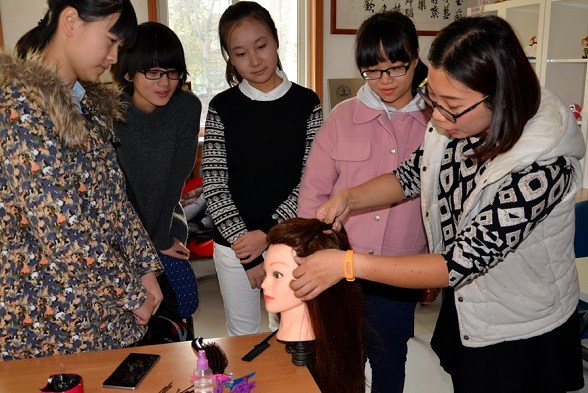
A trainer shows volunteers how to dress hair at an NGO incubator park in Jinan, Shandong province. (Photo Provided To China Daily)
Governments are increasingly using the organizations to provide services for communities.
On Jan 8, the Ministry of Civil Affairs released a guideline that encouraged local governments to further develop NGOs to ensure they play an increasingly active role in social governance at the grassroots level.
In recent years, the number of government-backed NGO incubators, which identify promising startups and provide training programs, has mushroomed.
Since 2012, one incubator in Jinan, capital of Shandong province, has hatched hundreds of NGOs, which have helped to tackle problems the city government is unable to handle owing to a lack of personnel or professional skills, or both.
Before 2016, when the Jinan government adopted the Qianshou Xiyang, or "Join Hands with Seniors", program, few elderly people in the city's Chengpinyuan community knew each other.
Many "empty-nest seniors", people whose children work in other cities or even overseas, were living isolated lives and had developed serious psychological issues as a result. However, few people, including their families, realized problems existed.
"But after the social workers intervened, seniors began stepping out of doors to join activities such as sports meetings. Those with shared interests formed their own groups. After receiving psychological counseling, many empty-nest seniors opened up and told us their sorrows," said Zheng Yi, director of the Raindrop Public Service Center, the NGO that developed Qianshou Xiyang.
The 22-year-old, who founded Raindrop when she was a third-year college student, registered the volunteer group with the local civil affairs bureau in 2016 and started providing government-funded services in the community.
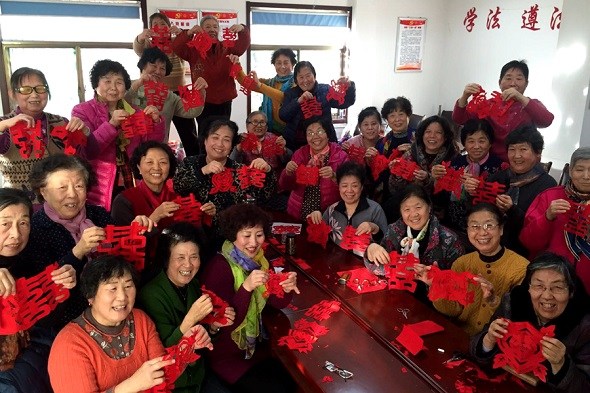
Seniors display paper-cuts made under the guidance of volunteers from Raindrop, an NGO in Jinan. (Photo Provided To China Daily)
Unsatisfactory results
"The central government spent a lot of money tackling social issues, such as aging (by providing benefits), but the results were unsatisfactory," she said, adding that solving social issues often requires more than simply handing out money. "Government employees are not really suitable for this sort of work."
Raindrop is one of 54 NGOs to have benefited from the assistance offered by the Social Organization Incubator Park in Jinan's Shizhong district, founded in 2013.
Qi Yuxin, secretary of the Shizhong association of social organizations, which oversees the park's operations, said NGOs such as Raindrop are playing active roles in fields such as assisting seniors, environmental protection and the preservation of traditional culture.
"These are fields where NGOs can supplement the role played by the government," he said.
Good governance
As social problems and conflicts become increasingly complicated, such as those between people's growing need for better lives and services and a lack of resources and professional service providers, more NGOs will be required to implement good governance, according to experts.
Wang Yongkui, a consultant with the Lixin Social Governance Consultancy in Qingdao, Shandong province, said governments excel at making arrangements on the macro level, but they are less capable of dealing with detailed, individual problems - the areas where NGOs stand out.
"The provision of public services, such as psychological counseling, legal education and conflict mediation, requires a higher level of professional knowledge and a smarter approach, which are weak points for governments. NGOs in different fields are far more suited to the job," he said.
Wang added that NGOs, which are formed by ordinary citizens, outperform governments in terms of mobilizing people. "Such factors are the key to social governance," he said.
Since the 18th National Congress of the Communist Party of China in 2012, the Party leadership has made repeated calls for the increased participation of "social organizations" - the Chinese term for NGOs, including foundations, citizens' groups and private nonprofit organizations - in social governance.
In his report to the 18th CPC National Congress in November 2012, President Hu Jintao urged Party bodies to guide social organizations so they would develop in a "healthy and orderly way" and fully engage members of the public in social management. Similar calls were made in the four plenary sessions that followed the congress.
In 2016, the State Council, China's Cabinet, issued a guideline on reforming the management of social organizations and promoting their development, which required local authorities to streamline their administrative procedures and step up efforts to develop NGOs. It also called for social work professionals to be assimilated in a national talent pool and treated the same as professionals in related industries in terms of qualifications and financial benefits.
At the 19th CPC National Congress in October, President Xi Jinping said the Party would develop the role of social organizations, and ensure that "the government's administrative efforts, society's self-regulation and residents' self-governance support each other".
Challenges
Zheng, Raindrop's director, said a lack of funding and poor management skills are the biggest challenges facing startup NGOs.
"To register Raindrop with the authorities, I was told to provide an office address. But for recent graduates like me, an office in Jinan is unaffordable," she said. "In addition, we spend most of our time in communities, so a fixed office is impractical."
However, she was fortunate: the problem ceased to be an issue when the Shizhong civil affairs bureau founded the Social Organization Incubator Park to aid the development of NGOs. The facility was based on existing models in Beijing, Shanghai and Guangzhou, Guangdong province - the places where NGOs are most active.
When it opened, the park began recruiting startup NGOs whose services could potentially benefit local communities and complement the government's role.
New NGOs are provided with free offices and training related to social work and management skills for 10 months, and the park authorities help them to apply for financial support from the government, usually 5,000 to 10,000 yuan ($777 to $1,555) per program.
The management has also invited legal and auditing professionals and mature NGOs to base themselves in the park to ensure that their services are inexpensive and readily available. Fledgling NGOs are required to leave the park once they are able to operate independently and governments begin purchasing their services.
Qi, from the Shizhong association of social organizations, said startup NGOs are also provided with specific services, such as policy interpretation seminars to enable them to fully understand and react to new government strategies.
Training
The Shizhong district association of social workers is one of the mature NGOs in the park. It provides training for social workers and matches them with startup NGOs in different areas. Ren Yan, the director, said the association has trained 86 social workers and satisfied the "startup NGOs' need for talent".
In addition, the local government provides mature NGOs with 60,000 yuan to 80,000 yuan a year to encourage them to develop community-level organizations, usually in the form of interest groups or groups that control their own affairs.
One such group is Lan Majia or "Blue Vest", a volunteer group formed by 65 retired Party members.
The group provides voluntary services in the community, such as security patrols and the removal of illegal posters, three times a week, and the funds the group receives are used to buy cleaning equipment and uniforms.
"These mini-NGOs help to bring community governance back to local people, whose ideas are usually tailored to suit their own needs," Ren said.
Although incubators have been crucial to the development of fledgling NGOs, there is still room for improvement.
Wang, from the Lixin Social Governance Consultancy, said the incubators alone will not be sufficient to foster new NGOs, because the process is only effective if it is supported by complementary policies, especially those related to local government purchases of services.
"Some local authorities are not open-minded enough. Even when they fail to excel at certain tasks, they are unwilling to purchase services from the nongovernmental sector," he said.
Marketing
Zheng, Raindrop's director, is hoping that a recently founded department in the Social Organization Incubator Park will provide consultancy services related to brand marketing. "Many startup NGOs have little awareness of brand value, which is a real problem," she said.
Qi, from the Shizhong association of social organizations, said local governments should further diversify their "shopping lists" for services to foster fledgling NGOs in a range of fields.
"At present, governments mainly favor programs related to poverty alleviation or those that provide assistance to people with disabilities or to seniors. They rarely invest in programs that focus on environmental protection or the preservation of culture, but these are equally important issues," he said.