
Japan's Takaichi may call early election
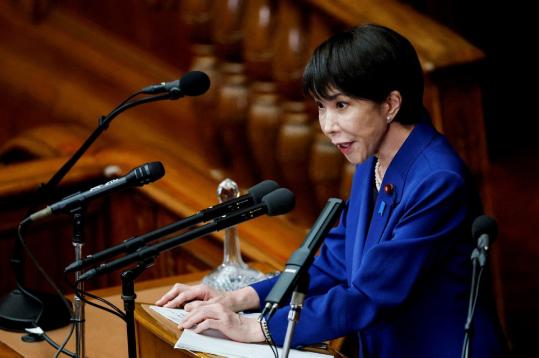
Japanese Prime Minister Sanae Takaichi may call an early general election, the head of her party's coalition partner said on Sunday, after media reported she was considering a February vote.
Hirofumi Yoshimura, leader of the Japan Innovation Party, told public broadcaster NHK that he had met with Takaichi on Friday and felt her view on the timing of an election had shifted to a "new stage".
"I wouldn't be surprised if she made the decision as reported by the media," Yoshimura said. The Yomiuri Shimbun reported on Friday that Takaichi was considering holding a snap election on Feb 8 or 15, citing government sources.
Yoshimura said he and Takaichi did not discuss the specific timing of any election.
Takaichi was mum on when she would call an election during an interview with NHK that was aired on Sunday.
Takaichi, an advocate of big spending to boost Asia's second-biggest economy, said she had just instructed her Cabinet ministers to ensure the timely execution of the supplementary budget for the fiscal year through March and parliamentary approval of next fiscal year's budget.
"At present, I am focusing on the immediate challenge of ensuring that the public feels the benefits of our stimulus policies aimed at cushioning the blow of inflation," she said.
However, Tetsuo Saito, head of the opposition Komeito, said a February election "would make it impossible to pass the budget by the fiscal year-end, at a time when Japan's economy faces a critical phase". He told NHK that he was surprised by the reports that Takaichi was considering dissolving parliament when it convenes on Jan 23.
Takaichi's $783 billion spending proposal, her first budget as prime minister, includes her flagship spending program. The yen fell against the dollar on Friday after the Yomiuri report on her election plans.
Food inflation
Japan's economy has weathered the hit from higher United States tariffs, but stubborn food inflation has weighed on consumption.
If Takaichi cannot enact the budget by the end of March, her government would have to compile a stopgap budget, which could delay execution of spending measures.
Japan's Internal Affairs Ministry issued a statement on Saturday urging regional election committees to start preparing in case of an early election. While the ministry said it was just responding to media reports, political analyst Shigenobu Tamura said the statement meant the election was a "done deal".
Yoshihiko Noda, a former prime minister and head of the largest opposition group, the Constitutional Democratic Party of Japan, said he had expected Takaichi to pass the budget before calling an election but now felt she would dissolve parliament on January 23.
Meanwhile, the city assemblies of Hiroshima and Nagasaki have adopted statements urging the Japanese government to adhere to the country's Three Non-Nuclear Principles, Kyodo News reported.
The Hiroshima City Assembly unanimously adopted its statement on Friday, saying the ruling party's attempt to revise the principles has caused concern. It strongly urged the government to take seriously the feelings of people in the atomic-bombed cities and to uphold the Three Non-Nuclear Principles.
The Nagasaki City Assembly passed its statement on Thursday by a majority vote, saying successive governments have regarded the principles as a national policy. It said the ruling party's intended revision of the principles while amending the country's security documents is totally unacceptable.