
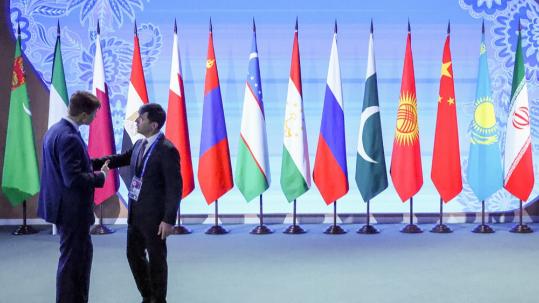
SCO rejects any unilateral, coercive measures
The Shanghai Cooperation Organization (SCO) member states said on Tuesday that they reject any unilateral and coercive measures that violate international law or impede international cooperation.
In a joint communique issued at the 24th Meeting of the Council of Heads of Government of Member States of the SCO, the heads of the delegations said that member states oppose any unilateral and coercive measures, including economic measures, that violate the UN Charter and other norms of international law, or impede international cooperation and the UN Sustainable Development Goals.
The SCO member states, according to the communique, have pledged that they will firmly uphold an open, transparent, just, inclusive, fair and non-discriminatory multilateral trading system.
They will also resolutely push forward the improvement of the global financial governance system and enhance the role of developing countries in international financial institutions.
The SCO delegation heads noted that international relations are currently undergoing profound and historic changes.
They also observed that the status of the Global South countries is constantly rising and their role as a new political and economic center is increasingly prominent, creating opportunities for their own development as well as for equal and mutually beneficial international cooperation.
The heads of the delegations also expressed deep concerns over the intensifying fragmentation of the world economy.
They reaffirmed that member states will continue to improve the global economic governance system and consolidate the multilateral trading system with the World Trade Organization at its core.
In the communique, the heads of the delegations stressed that member states will be committed to building a broad and open economic space in the region.
They are also committed to promoting equal and mutually beneficial cooperation to ensure the effective operation and flow of markets, supply chains, settlement and payment, transportation corridors, logistics routes, as well as investment, goods, services and technologies.
Guaranteeing energy security
According to the joint communique, the SCO member states also pledged to guarantee energy security and energy market stability.
The joint communique said member states are committed to advancing the future joint vision of maintaining global energy security and forming a fair, balanced and sustainable global energy development pattern.
The SCO member states called for continued efforts to ensure energy security and energy market stability and to build a diversified energy balance system using fossil fuels, renewable energy, hydropower and hydrogen energy to guarantee the sustainable supply and demand of energy.
They also expressed support for conducting equal, sustainable and mutually beneficial international cooperation in the peaceful use of nuclear energy.
Supporting UN reforms
The SCO member states noted that UN reforms are necessary to ensure the representation of developing countries in UN governance bodies and to adapt the UN to current political and economic realities.
They expressed the belief that cooperation within the framework of the SCO will lay the foundation for forming an equal and indivisible security architecture on the Eurasian continent.
According to the joint communique, the SCO member states voiced their opposition to addressing international and regional hotspot issues through bloc-based and confrontational thinking.
They also reiterated that promoting the building of a new type of international relations featuring mutual respect, fairness, justice and win-win cooperation as well as building a community with a shared future for humanity are of practical significance.