
China to invest 5 trillion yuan in power grid over next 5 years
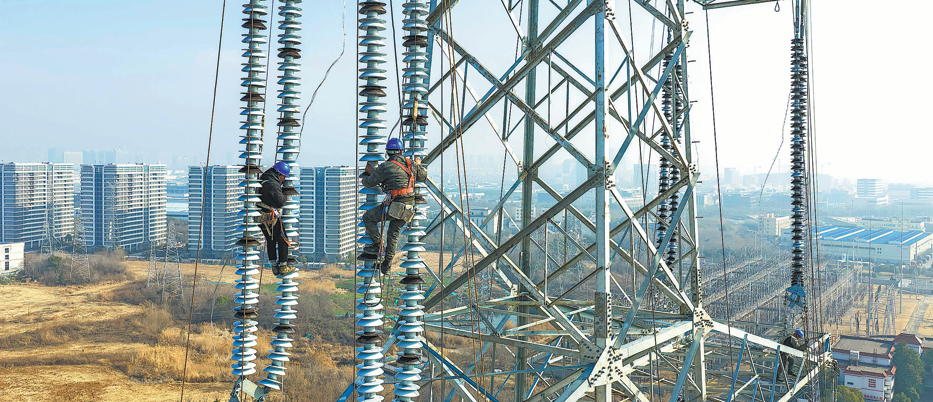
Construction workers from Jiangsu Power Transmission and Transformation Co install conductors at a 500-kilovolt line project site in Nanjing, Jiangsu province, on Wednesday. (SHI JUN/FOR CHINA DAILY)
China is set to pour a record-high 5 trillion yuan ($722 billion) into its power grid over the next five years, a massive investment in new infrastructure designed to eliminate renewable energy bottlenecks and propel the nation toward its 2030 carbon peak goal.
The substantial capital injection will also serve as a vital macroeconomic ballast to stabilize national growth and accelerate industrial modernization, said industry experts and company executives.
Beijing is pivoting toward advanced energy infrastructure to serve as the new bedrock of the economy, said Lin Boqiang, head of the China Institute for Studies in Energy Policy at Xiamen University.
By nearly doubling the capital expenditure of previous cycles, Beijing is leveraging the utility sector to drive domestic consumption, anchor industrial supply chains and foster new quality productive forces across the country, Lin said.
The scale of the commitment was formalized in January when State Grid Corp of China, the world's largest utilities enterprise, announced it would invest 4 trillion yuan in fixed assets during the 15th Five-Year Plan (2026-30) to accelerate the development of a high-quality supply chain for its new power system.
This represents a 40 percent jump from the previous five-year cycle, bringing its average annual spending to a record 800 billion yuan, it said.
Hot on its heels, China Southern Power Grid, which serves the country's southern industrial hubs, including Guangdong, Yunnan, Guizhou and Hainan provinces, as well as the Guangxi Zhuang autonomous region, disclosed a 180 billion yuan budget for 2026 alone.
Analysts expect China Southern Power Grid's total five-year outlay to reach approximately 1 trillion yuan. This brings the combined total of the two dominant operators close to the 5 trillion yuan mark — nearly double the 2.64 trillion yuan spent during the 13th Five-Year Plan (2016-20).
Financial heavyweight Goldman Sachs believes grid investment in China has evolved from simple infrastructure into a structural reshaping focused on absorbing volatile green electricity and supporting the power requirements of artificial intelligence.
The sharp increase significantly outpaces previous cycles, establishing a new benchmark for high-speed expansion within the sector, a Goldman Sachs report said.
With renewable energy projected to account for 30 percent of total power generation by 2030, its inherent intermittency and volatility are expected to place immense pressure on stable grid operations.
As a result, higher renewable integration will inevitably exacerbate grid volatility, structurally necessitating a higher degree of investment in intelligent systems, the report said.
Goldman Sachs believes ultrahigh voltage transmission will be the fastest-growing segment in 2026, with an expected year-on-year increase of 24 percent.
From 2028 to 2030, grid investment is forecast to shift toward smart infrastructure. This implies an unprecedented strengthening of the grid's "nervous system" — comprising software, control systems and sensors — and its "capillaries", such as distribution and microgrids, it said.
Ye Xiaoning, a senior engineer at the new energy department of the State Grid Energy Research Institute, said the consistent upgrades of grid and transmission infrastructure in China, the world's largest consumer and producer of renewable energy, have drastically improved the nationwide optimization of renewable energy resources.
By bridging the geographical gap between the wind-swept western provinces and the energy-hungry eastern coast, Beijing is successfully mitigating the curtailment issues that once hampered its solar and wind sectors, he said.
According to Goldman Sachs, as distributed power sources, electric vehicle charging piles and virtual power plants are integrated into the network at scale, traditional passive distribution grids must be upgraded into active, flexible and mutually supportive smart platforms.
Consequently, investments in smart meters, automation terminals and distributed control systems will serve as a more sustainable growth engine than traditional towers and transmission lines, it said.
The financial heavyweight believes a new grid platform centered on ultra-high voltage, smart distribution and digitalization is the only viable path to accommodate high proportions of wind and solar energy while meeting the new quality load demands of artificial intelligence computing.
According to International Energy Agency forecasts, global information technology loads are expected to see a cumulative increase of 106 gigawatts between 2025 and 2030.
To ensure a stable and efficient power supply, distribution systems have become a critical component, now accounting for approximately 10 percent of total data center investment, the IEA said.
Both grid giants have vowed to move toward a more market-oriented framework by organizing flexible interprovincial mid-to-long-term trading and conducting routine power exchanges across different operating zones.
Furthermore, the utilities will enhance the grid's operational resilience by leveraging the flexible regulation capabilities of pumped hydro storage, new energy storage systems and virtual power plants to optimize resource allocation nationwide.
This surge in spending is primarily designed to eliminate long-standing constraints that have hindered China's green energy transition, said Lin from Xiamen University.
Despite leading the world in wind and solar installations, excess green power due to grid capacity used to restrain further development of renewable energy, he said.
Lin views this trillion-yuan annual spending as a sophisticated macroeconomic lever, offering high multiplier effects across the industrial chain at a time when traditional growth drivers are maturing.
For every billion yuan spent on UHV lines or smart substations, there is a corresponding surge in demand for copper, steel, power semiconductors and high-end software. "By investing and planning ahead, Beijing is effectively de-risking the industrial sector," he said.
China's investment in key energy projects reached a milestone last year, surpassing a record 3.5 trillion yuan as China steps up its transition toward a greener power grid.
China currently holds the world record for the longest safety run of a major power grid and operates at the highest voltage levels globally, including its signature UHV direct current lines that are capable of transporting electricity across thousands of kilometers with minimal energy loss — a feat comparable to sending power from New York to Los Angeles.
Zhang Lin, director of planning and development at the China Electricity Council, said that strengthening the synergy between the backbone grid, local distribution networks and microgrids is now a strategic necessity.
This deeper integration is essential to support emerging energy business models and ensure that renewable energy providers can participate on a level playing field within the national power market, she said.
According to the investment plans by the two utility giants, the updated grid will also be engineered to accommodate 900 million kilowatts of distributed new energy, such as rooftop solar.
There will also be a massive expansion of the nation's electric vehicle infrastructure, providing the essential capacity to support more than 40 million chargers nationwide. These targets reflect a shift from simply building renewable plants to ensuring that clean power actually reaches the end consumer.
State Grid Chairman Zhang Zhigang recently emphasized that the utility must play a "foundational and leading role" in stabilizing growth. He said that investment should be "moderately ahead of demand" to support the nation's major strategic projects and strengthen the resilience of the industrial supply chain.
China Southern Power Grid has echoed this sentiment, stating it will leverage its vast investment scale and long industrial chain to serve high-quality economic development.
The company plans to spend at least 50.6 billion yuan on massive equipment updates and digital-intelligent transformation this year alone, ensuring the grid remains resilient at its furthest capillaries.
Analysis from market experts suggests that the wave of capital will create a powerful pull effect across the entire industrial chain.
According to AVIC Securities, sectors involved in UHV technology, main grid equipment and distribution network upgrades are expected to see a multi-year windfall as the nation moves to replace aging hardware with smarter, bidirectional components.
The rapid growth of new energy installations, together with the global boom in AI that is quickly translating into massive demand for power infrastructure tailored for AI data centers, is driving an unprecedented wave of global investment in grid modernization and upgrades, it said.
Furthermore, robust global demand for grid upgrades is creating significant overseas opportunities for Chinese equipment manufacturers, who leverage a comprehensive industrial system, supply chain advantages and the nation's "engineer dividend". The trend is only expected to accelerate amid increasing global IT loads, AVIC Securities said.