40 years of opening up, the rising of China in a new era
2018-03-27 10:15:50 CGTN Gu Liping
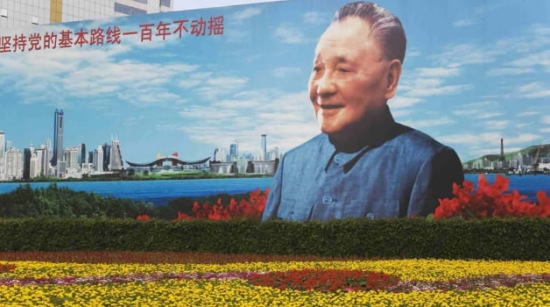
A billboard of China's late paramount leader Deng Xiaoping. /CGTN Photo
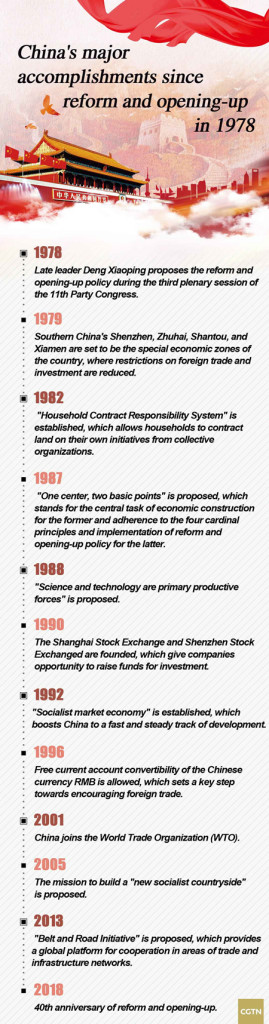
In 1978, China’s late paramount leader Deng Xiaoping proposed the idea of internal reform and opening up to the outside world during the third plenary session of the 11th Party Congress, vowing to push for economic development in both urban and rural areas.
"Without reform and opening-up, there will be no hope for China," Deng said. "Development is the hard truth."
Since then, China has embarked on widespread economic reforms, while widely opening its market to the world, which is set to be further discussed in the 2018 Boao Forum for Asia (BFA) on April 8-11. Experts will elaborate on how China has changed the world, and vice versa.
China's achievement over the past 40 years
Drastic changes have taken place since the adoption of the reform and opening-up policy. The then impoverished nation has turned into one of the world’s largest economy, with its gross domestic product (GDP) reaching 82.71 trillion yuan in 2017, or 13.11 trillion US dollars, rocketing over 236 times than that of four decades ago.
Here's a look back at China's major accomplishments since 1978.
As President Xi Jinping pointed out in his 2018 New Year Address, reform and opening up "has been the only path to the realization of the Chinese dream". Xi vowed to press ahead with reform in 2018.
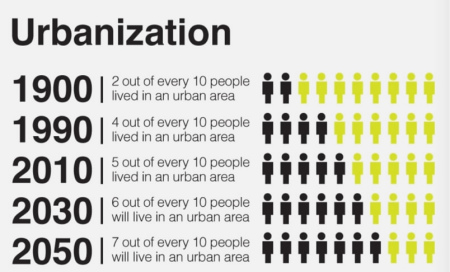
Urbanization: A necessary path toward modernity
Urbanization, a major reform process where people from rural places shift to urban areas, serves as a key engine for sustainable economic growth, as it can bring up domestic consumption and investment.
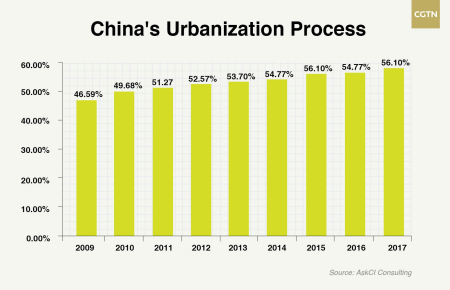
In 2017, permanent urban residents, including those who migrate from countryside, account for 58.5% of China’s population—roughly 809 million people. That rate is expected to hit 60% in 2020.
As an important part of structural reform, China’s urbanization program has extended itself to developing city clusters, which coordinated regional development and urbanization, as Xi stressed at the 19th CPC National Congress which ended four months ago.
The coordinated development of Beijing, Tianjin and Hebei Province, also known as Jing-Jin-Ji, is one of the strategies, aiming to create a world-class cluster in northern China.
He Lifeng, director of China’s National Development and Reform Commission, said in March that the area would help distribute wealth that had been sucked into Beijing to the areas surrounding the capital ? many of which are still impoverished villages.
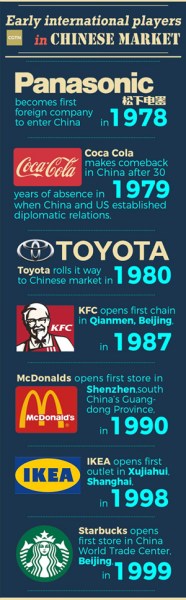
Reform has released great potential of the Chinese people, while the opening-up brought enormous opportunities for the overseas companies.
China keeps its door wide open
A series of measures have been put forward to reduce the restrictions on foreign trade and investment.
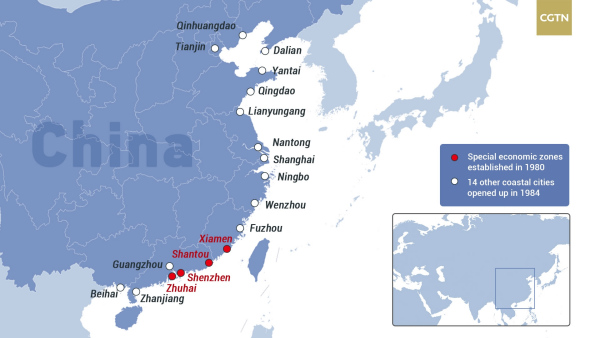
In 1980, the CPC Central Committee and the State Council decided to name four southern China cities, namely Shenzhen, Zhuhai, Shantou and Xiamen, as special economic zones of the country. The establishment of these economic zones marked the further development of China’s opening up.
Thus, the country decided to fasten its pace. In 1984, 14 other coastal cities all over the nation have been opened up, with all of their geographical advantages unleashed.
As Xi noted during a meeting with the Communist Party of China (CPC) Central Committee Political Bureau members, “World’s prosperity and stability is China’s opportunity, while China’s development being world’s opportunity.”
Forty years of China’s rapid development has pushed the world’s economy forward, motivating the world’s economy from gentle recovery to steady growth. China has not only benefited itself, but also pushed the whole world ahead.