
Insights | China a key supporter for global development and global youths hope to build bridges of cooperation: UNIDO expert representative
By Xue Lingqiao
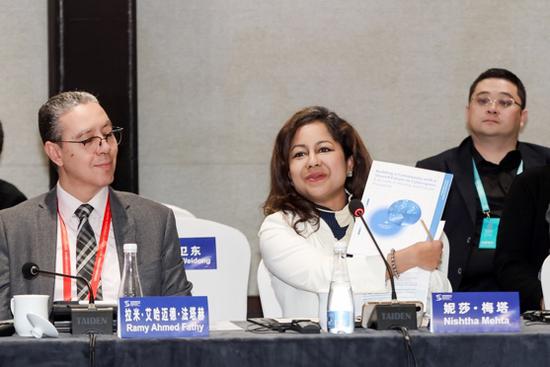
"China has transitioned from being a recipient of development assistance to a leading provider of finance, technology, and capacity-building. The United Nations Industrial Development Organization (UNIDO) views China as a strategic partner and an active contributor to global industrial development," said Nishtha Mehta, a Change Facilitator and Regional Program Expert for Centers of Excellence in AI and Digital Transformation of UNIDO, in a recent interview with China News Network during the 2025 World Internet Conference Wuzhen Summit held in East China’s Zhejiang Province.
During this year's summit, global development was a key focus for many Chinese and international guests. On this topic, Mehta stated that Inclusive and Sustainable Industrial Development (ISID) is at the heart of UNIDO's global agenda and as reaffirmed in the Lima Declaration and embedded in the United Nations Sustainable Development Goals 9, which highlights industry, innovation and infrastructure.
She pointed out that UNIDO's development strategy focuses on three key aspects: first, creating shared prosperity; second, promoting economic growth; and third, protecting the environment. Accordingly, Mehta also highlighted the practical directions in which China and UNIDO are collaborating, mainly covering climate action and green supply chains, technology transfer and capacity building, and digital and green transitions.
Regarding specific measures at the above levels, she believes that both sides can deepen cooperation for joint efforts under South-South cooperation to scale use of renewable energy, green hydrogen, and the circular economy, and leverage China's effective experience in industrial parks and clean energy to foster cooperation between developing and developed countries. Additionally, the two sides can further collaborate on industrial digitalization and smart manufacturing to empower global supply chains.
"During the Wuzhen Summit, I participated in a forum on promoting the 'Global Development Initiative.' It was inspiring to see so many countries gathered together. In my view, the content of this initiative aligns closely with UNIDO's philosophy, as we both support promoting industrial upgrading and green industrialization in the Global South," Mehta said.
How can China and UNIDO expand South-South cooperation? In response, Mehta stated that first, successful development models should be leveraged, such as UNIDO's ITPO network and regional coordination centers in China to broker investment and technology partnerships. Second, to promote renewable energy hubs, including initiatives such as the UNIDO International Solar Energy Center in Northwest China's Lanzhou and the Global Cleantech Innovation Programme that enables small and medium-sized enterprises to adopt clean technologies. Third, to facilitate joint training and establish innovation labs.
"Here at the World Internet Conference and Wuzhen Summit, many discussions are about how institutions, academia, businesses, and policymakers can deeper the work together to achieve skills upgrading. This should not only be theoretical but also involve practical training, returning value to employees of different organizations, and building relevant communication networks," said Mehta.
Regarding the empowering role of new application scenarios such as the Internet of Things and artificial intelligence in economic and social development, Mehta pointed out that these new technologies can enhance productivity and development efficiency, achieve predictive maintenance in infrastructure and development, and optimize supply chains.
"However, we still need to note that challenges such as the digital divide persist. Some at the summit also mentioned the smart divide, along with limitations in infrastructure and gaps in skills among countries. Therefore, I believe intermediary institutions and organizations like UNIDO can help address these issues," Mehta said.
In this regard, Mehta emphasized that UNIDO has already launched several projects to bridge these gaps. First, the Global Alliance on Artificial Intelligence in Industry and Manufacturing (AIM) is established. Second, smart factory labs have been set up, with pilot projects currently being implemented in Africa and Asia to train local talent in advanced manufacturing technologies. Third, policy advisory services and skills development are being promoted.
She also encourages everyone involved in AI enablement, research & academia, policymakers and regulators, development agencies, financial institutions, manufacturing enterprises and talent capability builders to sign up for AIM global community and exchange resources.
"In all aspects, I believe we can not only inspire young people but also learn from them," Mehta concluded. In the bridge-filled water town of Wuzhen, she called on everyone, using the metaphor of a 'bridge' to see themselves as bridges, inviting others to become part of this growing bridge network—connecting resources, connecting people from all countries, and connecting everyone's ideas.