
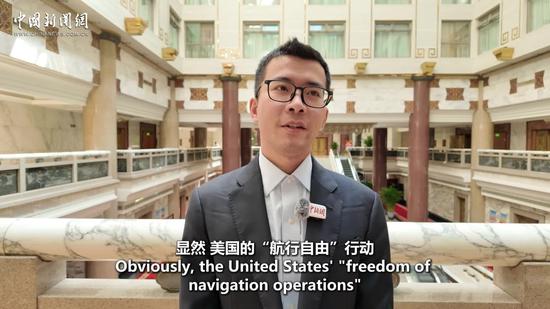
U.S. 'Freedom of Navigation' operations stir tensions, undermine international maritime order: expert
(By Feng Xiaoyan)
(ECNS) -- The United States’ military provocations across global waters under the banner of "freedom of navigation" have become a major source of regional friction and a destabilizing factor for the international maritime order, an expert told China News Network recently.
The U.S. operations are not aimed solely at China. Neighboring countries in the South China Sea have also been affected, said Bao Yinan, an associate research fellow at Huayang Center for Maritime Cooperation and Ocean Governance.
“The U.S. seeks to portray itself as fair and impartial by challenging even its allies’ maritime claims,” he said. “Yet in practice, very few countries have amended their national laws following such challenges, highlighting a significant gap between Washington’s stated intentions and the actual outcomes.”
Bao emphasized the need to clearly distinguish between two fundamentally different concepts in terms of “freedom of navigation.” One is the U.S.-led Western “military freedom of navigation,” or the so-called “freedom to act recklessly”; the other is the freedom of navigation accepted by the international community, which aims to ensure the smooth flow of key international trade routes.
He noted that China is currently committed to building a maritime community with a shared future and developing the South China Sea into a sea of peace, friendship, and cooperation. “In this context, correctly understanding the essence of freedom of navigation is particularly important,” Bao said.
China’s position, he continued, reflects its firm commitment to upholding the contemporary international maritime legal system centered on the 1982 United Nations Convention on the Law of the Sea (UNCLOS). As a State party to UNCLOS, China has the responsibility to speak out on international platforms and oppose the distortion of international rules for self-serving purposes. “Such a responsible attitude demonstrates China’s role as a major country,” he added.
The future trajectory of U.S. policy remains uncertain. Bao pointed out that during U.S. President Donald Trump’s first term, he conducted “freedom of navigation” operations at a high frequency, exceeding the total number carried out under his predecessors, presidents Joe Biden and Barack Obama. He noted that in Trump’s first term, the number of such operations targeting the South China Sea was roughly twice the combined total under the Biden and Obama administrations.
Since the start of Trump’s second term, these operations have so far been relatively limited. However, given the traditionally unpredictable nature of his policies, it remains to be seen whether he will again use “freedom of navigation” operations as a tool to exert pressure on China.