
(W.E. Talk) China draws global attention as 15th Five-Year Plan charts course for economic development
By Zhang Dongfang, Chen Tianhao, and Gong Weiwei
(ECNS) -- The Recommendations of the Central Committee of the Communist Party of China (CPC) for Formulating the 15th Five-Year Plan for National Economic and Social Development was made public on Tuesday. Self-reliance in science and technology, high-quality development, high-standard opening up, mutual benefit and win-win outcomes, and other focuses have sparked global discussion, demonstrating the significance of China's development plan for the next five years to the world.
15th Five-Year Plan sends positive signals
Compared with the 14th Five-Year Plan period (2021-2025), the 15th Five-Year Plan was formulated amid a more complex and severe domestic and international environment. Experts believe that the 15th Five-Year Plan sends a clear signal that China is actively responding to challenges and firmly advancing opening up.
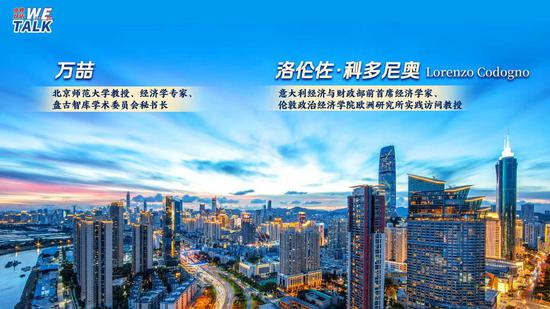
Lorenzo Codogno, former Chief Economist and Director General of Italian Ministry of Economy and Finance and Visiting Professor of the London School of Economics and Political Science (LSE), pointed out that consumption is still weak in China, while the global economy suffers from major imbalances, with Europe lacking investment and the United States lacking savings.
The 15th Five-Year Plan suggests to strengthen domestic consumption, which is positive, said Codogno. He further noted that China's Five-Year Plans are becoming increasingly flexible. They send positive signals to the global economy, clarify China's key investment priorities, and showcase future development opportunities.
He believes that as China communicates a clear development path to the global economy, its economic operations will advance along the predetermined track, and Europe should learn from China's approach.
Wan Zhe, an economic expert and professor at Beijing Normal University, and secretary-general of the Pangoal Institution academic committee, pointed out that the current global landscape is undergoing profound adjustments. Economic globalization is encountering headwinds, unilateralism and hegemonism persist, trade protectionism is intensifying, and great power game is expanding to core areas such as technology. The structure of global governance is in a period of reshaping.
Wan stated that domestically, China faces issues such as insufficient demand, bottlenecks in the major circulation, and pressures on employment and household income growth.
"This means China must pursue development in a fragmented and evolving global rule environment," she said, adding that the 15th Five-Year Plan conveys clear and stable policy signals, aims to prevent economic disruption resulting from policy swings, and provides a long-term strategic guideline for national governance.
Overall, the 15th Five-Year Plan is, in this challenging era, a declaration of how China intends to advance against the tide, she said. “It focuses both on solving its own development problems and on striving to become a certain, open, and cooperative force in a turbulent world."
High-standard opening up highlighted in 15th Five-Year Plan
The Recommendations of the Central Committee of the Communist Party of China (CPC) for Formulating the 15th Five-Year Plan for National Economic and Social Development highlighted high-standard opening up. Guided by the document, China will expand high-standard opening up and create a new situation of win-win cooperation.
Wan stated that China's commitment to high-standard opening up is a proactive move to counter deglobalization and a firm choice made after understanding major trends.
High-standard opening up is independent opening up with institutional openness at its core, signifying a shift from simply lowering barriers to establishing new rules and the focus of opening up is transitioning from the traditional flow of goods and factors to steadily expanding institutional opening up.
This indicates that China is more actively aligning with high-standard international economic and trade rules, and improving its own regulations, governance, and standards, she said.
"China will not respond to protectionism with isolation, but will safeguard the multilateral trading system and ensure the stability of global industrial and supply chains with even greater opening up," she said.
She further pointed out that as Chinese companies pursue a "China+N" global layout, the connotation of opening up is expanding from the focus on "bringing in" in the past to equal emphasis on "going global" today. It also includes building global supply chains centered on China, and forming a new opening-up pattern of "in China" and "for China." This shift will bring enormous market opportunities to the world.
Codogno also stressed that, whether from the perspective of its own interests or the common interests of the rest of the world, China should adhere to economic openness and foster an environment conducive to free trade.
He noted that as the world is increasingly divided into blocks, “emphasis on multilateral organizations, such as the WTO, the UN, and all the international organizations should maintain geopolitical stability and should maintain an open trading environment that is beneficial for economic growth globally.”
He further emphasized that previously, in the face of the global trade war initiated by the U.S., China has always had a very long-term approach, a very calm approach. “There is a need for Europe and China to strengthen economic relations in order to maintain an open and trade and investment environment globally.”