
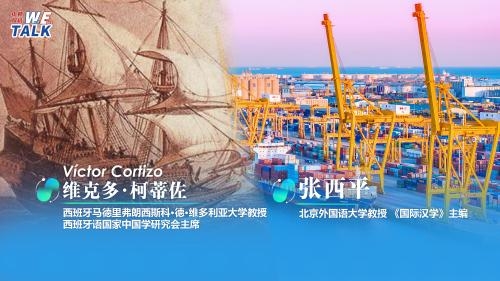
(W.E.Talk) China-Spain exchanges enter new chapter after 400 years of Manila Galleon's first visit
By Gong Weiwei, Zhang Dongfang
(ECNS) – The year 2025 marks the 20th anniversary of the establishment of the comprehensive strategic partnership between China and Spain. What are the historical origins of China Studies in Spain and Latin America? What is the current state of cultural exchange between China and Spain? How can the world better understand China?
In the latest W.E. Talk, Zhang Xiping, a professor at Beijing Foreign Studies University, and Víctor Cortizo, a professor from Francisco de Vitoria University and president of the Hispanic Association of China Studies, had an in-depth discussion on these related topics.
Manila Galleon witnesses first peaceful encounter of China-West civilizations
China-Spain exchanges date back to the Age of Discovery. According to Zhang, beginning in the 16th century, Spaniards sailed across the Pacific from Mexico to Luzon Island, establishing trade links with the late Ming Dynasty through the port of Quanzhou in today's Fujian Province.
The world-renowned Manila Galleon trade lasted for centuries, carrying Chinese tea, silk, and porcelain to Latin America and on to Europe, while bringing Spanish silver into China, greatly boosting economic and cultural interaction between the two civilizations.
Zhang noted that the long-standing economic and trade exchanges between Spain and China trace back centuries in the history and the Galleon trade not only marked the first peaceful encounter between Eastern and Western civilizations, but also laid the foundation for Spanish Sinology.
He pointed out that Spanish scholar Juan González de Mendoza's History of the Great and Mighty Kingdom of China and the Situation thereof became one of the earliest Western works on China Studies, making Spain among the first European nations to study China.
Zhang further pointed out that the three centuries between 1500 and 1800 marked a golden age of equal exchange between China and Europe, a chapter of profound importance in human civilization.
Cortizo echoed this view, emphasizing that the Manila Galleon facilitated not only the exchange of goods and silver but also the flow of ideas, communication, and religion, serving as an important testament to early China-West cultural interaction.
Rising interest in China Studies writes a new chapter in cultural exchange
In recent years, the number of people studying China around the world has increased significantly, with many outstanding scholars emerging in Spain.
Contemporary Spanish sinologists have also achieved remarkable accomplishments, said Zhang. For example, Alicia Relinque Eleta has translated Chinese classical literary works such as The Peony Pavilion, The Golden Lotus (Jin Ping Mei), and The Literary Mind and the Carving of Dragons (Wenxin Diaolong), and was awarded the 11th Special Book Award of China.
As China assumes a more prominent role on the global stage, Zhang pointed out that Chinese scholars should pay attention to the development of overseas China Studies. Citing Chinese reformist Liang Qichao, he noted that China Studies means studying China within China, within Asia, and within the world, highlighting that Chinese thoughts have global significance.
In Spain and across Latin American countries, more and more people are showing a strong interest in Chinese culture. Cortizo also observed that in Spain, not only students who learn Chinese but more academics are now conducting in-depth research on China's relations with Spanish-speaking countries.
Cortizo further noted that China has become one of Spain's key partners, investing in future factories and innovation projects in Spain, while Spain remains an important European market for China.
Acting as a bridge between China, Latin America, and Europe, Spain connects the Spanish-speaking and Chinese cultures, fostering deeper cooperation across regions, Cortizo added.
Zhang believes that sinologists need to gain a deep understanding of both historical and contemporary China, as only by integrating the two can one truly comprehend Chinese modernization.
"This sets a high standard for sinologists around the world," Zhang said. "We hope that more sinologists will come to China to experience the profound cultural heritage and dynamic vitality of Chinese modernization."