
Chinese learning opens 'cultural window' for South Africans
(ECNS)-- The growing popularity of Chinese language education in South Africa is offering young people not only a new language skill but also a gateway to Chinese culture, further strengthening ties between the two countries.
Sept. 17 marks the annual "Chinese Language Day" in South Africa, jointly established by China and South Africa in 2019. This year also marks the 10th anniversary of Chinese being officially included in South Africa's national education system.
said the rise of Chinese language education has added a vibrant "Chinese red" to South Africa, said Wu Changhong, foreign director of the Confucius Institute at the University of the Western Cape, in an interview with China News Service.
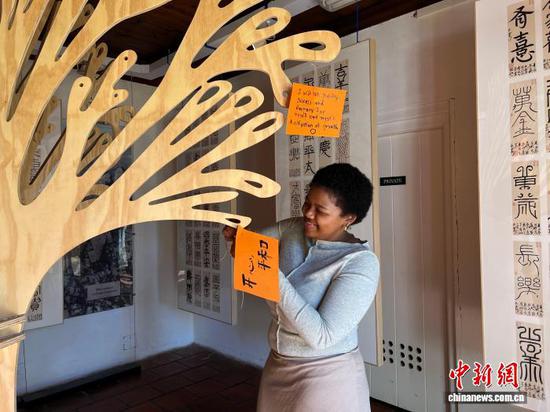
For many young South Africans, Chinese has become more than a means of communication. It has served as a bridge to better understand China while deepening friendship between the two nations. Alongside language study, students are showing growing interest in Chinese calligraphy, painting, martial arts and traditional medicine.
At Stellenbosch University's Confucius Institute, a special class on paper-cutting and digital heritage was held during an arts week at a local middle school. Around 40 students learned traditional Chinese paper-cutting techniques, creating designs such as the zodiac animals, pandas and traditional patterns. In addition to scissors and red paper, students used mobile apps and augmented reality technology to create digital versions of their designs.
Another class brought traditional Chinese clothing. More than 10 students swapped their uniforms into hanfu, qipao and other traditional garments, creating and editing short videos that quickly gained nearly 20,000 views on social media within a day.
Chinese clubs have become increasingly popular in South African schools, offering students a platform to showcase cultural diversity and creativity. Teachers say that the integration of short videos and social media helps attract more young people to Chinese language and culture.
Zheng Ruojun, Chinese director of the Confucius Institute at Stellenbosch University, added: "Young people love recording and sharing their lives through short videos. We hope more South African youth will fall in love with China through ‘shooting, editing, and sharing.'"
Antoinette Kruger, Chinese course coordinator at Stellenbosch High School, noted that the Chinese Club is not only one of the most popular student societies at the school, but also a showcase of the cultural diversity on campus.
The impact of Chinese learning extends well beyond the classroom. For 24-year-old Owethu Hlabisa, who joined a study trip to China this year, the country's rapid technological development and disciplined lifestyle left a strong impression. He said self-discipline is the value he most hopes to bring back to South Africa.
To date, South Africa hosts seven Confucius Institutes, two independent Confucius Classrooms and multiple teaching centers, the highest number in Africa. The rise of Chinese language learning is adding new vitality to people-to-people exchanges, enriching the cultural landscape of the "Rainbow Nation" with a touch of Chinese color.
(By Evelyn)