

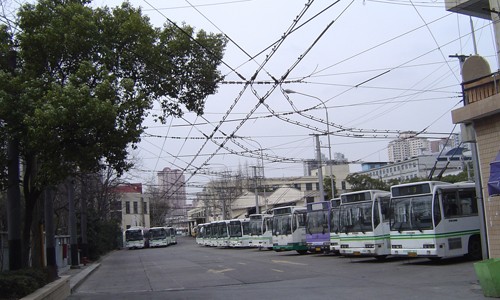
When 71-year-old Huang Xialan thinks about life without trolley buses (electric buses that draw power from overhead wires), she feels a deep sense of loss. Huang has used trolley buses for her transportation needs for nearly half a century. Every day for the past 10 years, the Shanghainese retiree has relied on No.14, the oldest trolley bus line in the city, to go to the park, supermarket, bank and doctor. She is so emotionally dependent on the service that she refuses to catch a regular bus that will take her to the same destination.
However, it might be time for Huang to say goodbye to her beloved trolley bus. The number of trolley buses only accounts for 1 percent of the city's buses. At one time there were over 900 trolley buses in operation; however, these days only 173 remain in operation along 10 routes.
Since all trolley buses must be scrapped after eight years, if there are no new trolley buses to take over by 2014, the 100th anniversary of trolley buses in Shanghai, people will only be able to see them in museums. Trolley buses have disappeared from 17 cities in China. In contrast, they are promoted in Western countries as environmentally friendly and relatively cheap vehicles to run.
Trolley buses have a special place in Shanghai's history. The city has the oldest trolley bus network in China, which has been in operation since 1914. During its 97-year history the vehicle shaped the city's landscape. Its passing invokes feelings of sadness among Shanghai's older residents whose early memories took place on many a trolley bus. "The trolley bus represents Shanghai's heyday in the 1930s and 40s. It also represents my happiest times," said 56-year-old Ji Jinxiang, who has been a trolley bus driver for 29 years.
Hail to the bus driver
Ji became a driver at around the same time the trolley buses entered their golden age. Since the mid-80s, trolley buses developed rapidly as the government planned to make them Shanghai's main form of public transport. Both routes and volume expanded. "I started my career traveling along Fuzhou Road Middle. It is the first trolley bus route in Shanghai. It lasted for 1.1 kilometers when it was first built, but expanded to 10 kilometers in the 80s, and now it covers 18 stops in 16.5 kilometers," Ji said.
According to Ji, at that time, the trolley bus was also the center of people's attention. It was regarded as a symbol of high social status, during an age when the majority used bicycles as their main form of transport. "I was very proud to be a trolley bus driver," Ji said.
For his first working day, he spent 7.65 yuan ($1.19) on a new pair of leather shoes. It was a very lavish purchase for the time, as the average monthly salary in Shanghai was around 30 yuan then. "I dressed up so I could match my job and the bus I drove," Ji said.
Wearing his first blue uniform, Ji said he could not help holding his head high. "People respected us, and envied us as we were the few who could have driving experience," he said, adding it was common for passengers to stand beside him and watch him drive with great interest.
It was no easy feat driving a trolley bus at that time. Many were 14-meter-long articulated buses, with a pivoting joint which held together two sections. They were called "giant dragons" as they were bulky and long. "Some female drivers needed to stand to turn the steering wheel to make a left or right turn," Ji said.
In the mid-90s, all the "giant dragons" were replaced by smaller and quicker models. The interior of the trolley bus improved as well. Ji still remembers how hard it was to sweep the melon seed husks that dropped between the floorboards and the rolling door. "They were not comparable to the models we use now, with plastic floors, electronic doors and air conditioning," Ji said.
In 1994, the Shanghai trolley bus network reached its peak. There were more than 20 routes, with 986 vehicles in operation. Its urban passenger intake accounted for 30 percent of Shanghai's total passenger intake. Its scale of operation was the biggest in Asia and the third biggest in the world.
The price of progress
In the late 90s, when the city's transit system received massive restructuring many trolley bus routes were cancelled. Most were replaced by regular buses. By the end of the 90s, its number declined to around 500.
Over the last 10 years, the government has launched plans to redevelop the trolley bus network. In 2002, Shanghai Ba-Shi Trolley Bus Company was established, the company planned to introduce 800 to 1,000 trolley buses by 2010. In 2007, the government also announced a project to expand the trolley bus network. E-mail Print