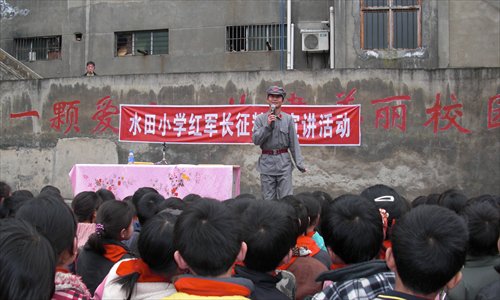
Chinese adventurer Yang Bo speaks to students at a primary school in Yunnan Province during his Long March trek
An experienced traveler despite his youth, Loehnis had a valuable instinct for retracing the route when directions led him astray.
"When climbing mountains, I aimed for the lowest horizon. When coming down, I followed the water because I knew it would always bring me to a village at some point. I stopped and listened for sounds. Dogs, chickens and ducks would always lead me to a village," he said.
Setting off in summer last year, it was late October when Yang reached the Jiajin mountain range in southwestern Sichuan. Overrun by thick vegetation, paths were slippery and the high-altitude triggered constant headaches.
The temperature was -20 C at the summit, and Yang battled continuous drizzle and snow on his lonesome.
"There was hardly enough air for to breathe, and I was almost too tired to survive the altitude sickness," said Yang, who mustered all his strength to keep pushing his cart. "If I had fallen from there, my life would have been in extreme danger."
While Yang could handle the rugged terrain, harder to take were the jeers and condescending comments some of his compatriots gave him along his journey.
Dressed in a gray Red Army uniform and hoisting a red flag, Yang's mission to spread the Long March spirit was sometimes met with cynicism even from locals in "revolutionary" counties.
"Most people think the Long March belongs in history and advocating spirit is unrealistic. People are busy making money nowadays, and are also cynical about society in general," he said.
But when Loehnis made his landmark journey as the first foreigner 20 years ago, the situation could hardly have been more different.
Despite the language barrier, he was welcomed and encouraged by almost everyone along the route. Knowledgeable locals often shared their expertise and helped Loehnis map out each phase of his trek.
"Almost everyone I met seemed to love the fact I was walking across China. They seemed particularly delighted that I was following the Long March," he said.
"It struck me that [Chinese villagers] held a great deal of admiration for those early pioneers, for their sacrifices and struggle. The fact that I was doing the Long March also helped me when the police stopped me."
'Red tourism' resistance
The reason for such contrasting attitudes, said Yang, is that growing materialism in society over the past 20 years has eroded the sense of community.
"People are getting rich, but they are still poor in regards to their spiritual pursuit. 'Red tourism' at revolutionary sites could help people feel more fulfilled and inspired," Yang said of a government-initiated tourism drive launched on the 70th anniversary of Long March in 2004.
Loehnis, now 42, still taps such a "spiritual" value from his Long March trek, using the event to remind him there are few insurmountable challenges in life.
"In some ways, it gives me inner-strength to know that it (the Long March trek) was not easy. There were at times a lot of pain and a lot of danger, yet to persevere was a big achievement. Today … I can more readily put 'small' things into perspective," he noted.
While conquering the Long March route might not be for ordinary tourists, "red tourism" appeals largely to middle aged Chinese travelers.
But for many young people whose main link to China's revolutionary past lies with their parents or grandparents, visiting sites made famous in history textbooks holds little allure.
Benjamin Tian, who studies political science at China Foreign Affairs University, said he has never visited a "red tourism" site even though his hometown of Changzhi, Shaanxi Province, has a Red Army museum.
"The idea of 'red tourism' is akin to indoctrination of an ideology. The revolutionary spirit promoted by the Party is too far away from reality, and a lot of young people are more engaged in striving for a better life. They just aren't interested in such ideology," he said.

Copyright ©1999-2011 Chinanews.com. All rights reserved.
Reproduction in whole or in part without permission is prohibited.