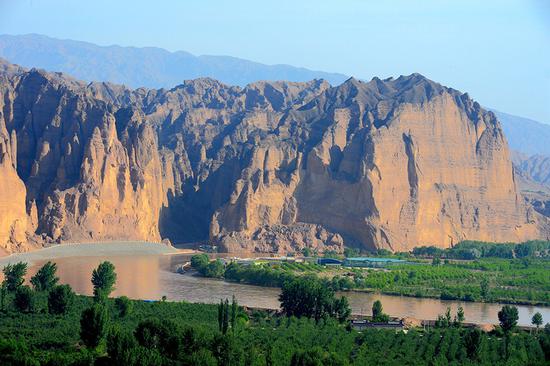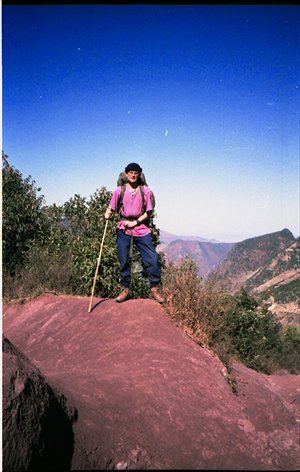
Barney Loehnis poses above the Three Gorges during his Long March trek 20 years ago. Photos: Courtesy of Barney Loehnis
In October 2006, the Party marked the 70th anniversary of the end of the Long March with books, a 20-episode TV series, documentaries and a musical production depicting heroic actions and drama of the trek. Even China's family of indigenous rockets used to launch satellites into orbit is named after the Long March.
Away from its glorification, controversy has been stoked by some scholars who question the Chinese historical account of the event. British historian Ed Jocelyn, who in November 2003 completed the trek with compatriot Andrew McEwen, writes in his book The Long March (2006) the 25,000 li (12,500 kilometers) Mao claimed the retreat spanned was a gross overestimation, with the real distance being closer to 6,000 kilometers.
Sun Shuyun, who wrote The Long March: The True History of Communist China's Founding Myth (2007), also questioned the historical accuracy of the 1934 Xiang River Battle in Jiangxi Province, arguing Communist troops had suffered a major loss due to widespread desertion rather than a heroic victory.
Answering the call of patriotism
Unlike history buffs, Loehnis' interest in retracing the trek was sparked by reading The Long March: The Untold Story (1985) by American journalist Harrison Salisbury.
Having already walked 6,000 kilometers from Istanbul to London just a few months after the collapse of the Eastern Bloc, Loehnis undertook the Long March to experience the remote Chinese countryside and examine the original trek's effects on locals.
But for Chinese adventurers, tackling the Long March can be a quest rooted in nationalism and nostalgia.
Yang Bo, a 41-year-old Guizhou native who in March capped off his Long March odyssey, said he wanted to experience the hardships the Red Army endured firsthand.
"Life is short and people's souls are weak. I felt my life would be more meaningful if I completed the Long March. The hike has indeed brought me many breakthroughs," said Yang, a former education training company worker in Guangzhou, Guangdong Province, who survived his 21-month trek with 50,000 yuan ($8,145) from his family.
"Only around one-tenth of the Red Army survived the Long March, but nevertheless the Party was able to take over the country. The Long March spirit played a major role in this accomplishment."
Pushing a 70-kilogram metal cart, Yang visited local Party offices during his trek to have his notebook stamped. He also spoke at schools to share his own experiences and keep the Long March spirit alive.
Same terrain, different receptions
The most difficult sections for both Loehnis and Yang were transversing the snowy Jiajin mountain range in Sichuan Province and crossing the high-altitude grasslands and marshlands between the Tibetan Plateau and the Sichuan Basin.
They often had to turn to locals to retrace the original route because some sections were either lost in under-developed mountainous regions or had been altered for road construction.
"There is such a fear of the grasslands in history and reality," said Loehnis, whose lack of spoken Chinese meant he relied on English teachers in the countryside when he encountered problems with village heads or the police.

Copyright ©1999-2011 Chinanews.com. All rights reserved.
Reproduction in whole or in part without permission is prohibited.