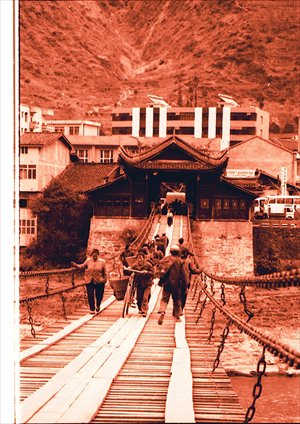
Villagers cross the Luding Bridge in Sichuan Province, site of a 1935 battle during the Long March.
Barney Loehnis wasn't quite the stereotypical backpacker when he left home in the UK and traveled to China 20 years ago. Sure, he was young, possessed a keen spirit of adventure and was determined to scrape by on a shoestring budget. But instead of planning an itinerary involving rickety overnight trains or packed buses, he hiked 9,000 kilometers across China to retrace the Red Army's historic Long March.
"I wake at six and it is barely light. My heart is pounding. I am riddled with apprehension about the endless unknown before me. I cannot speak the language. I do not know the laws concerning travel in China," Loehnis, then 22, wrote in his journal on the eve of his trek in October 1993, which began in Yudu county, Jiangxi Province.
"I have only managed to obtain a three-month visa for a nine-month journey. I have not walked more than a gentle stroll in the past three years. And now before me is 6,000 miles of remote and unchartered country."
Despite its uncompromising terrain including 18 mountain ranges and 24 rivers and a propaganda-rich hangover, the Long March still beckons Chinese and foreign adventurers as a "red tourism" pillar. However, surprising derision directed at some people who trek it today has raised doubts over whether Long March nostalgia has reached the end of the road.
Following history's footsteps
Loehnis had been warned of bandits, bureaucratic police and even wolves while planning his Long March journey, yet he was prepared for the adventure of a lifetime with his 30-kilogram backpack containing his tent, sleeping bag, clothing and other provisions.
Loehnis was following in the footsteps of Communist forces led by Mao Zedong 59 years after their famous retreat from Generalissimo Chiang Kai-shek's Kuomintang Army. In a circling retreat to the west and north covering 14 provinces over 370 days, the journey ended on October 19, 1935, in Yan'an, Shaanxi Province.
Loehnis ended his trek in Wuqi county, north of Yan'an, in June 1994, becoming the first foreigner to conquer the Long March route.
"Even now, I still feel the pains in my body," recalled the scholarly-looking Loehnis, lost in thought over a tumbler of vodka in a downtown Beijing Irish pub. "Blisters on my feet were always tough, but you get used to these things. Pain is a temporary problem, but memories are eternal."
Loehnis, who now works for an advertising agency in Hong Kong but still routinely visits Beijing, has taken the final step of modern Long March trekkers by writing a book titled The Long March Revisited, which will be published next year.
Different historical depictions
The Long March, which helped seal Mao's rise to power, remains one of the most storied events in the Party's history. The epic retreat's completion despite fatigue, hunger and sickness claiming nearly 70,000 lives inspired a spirit among Chinese of overcoming hardship, no matter how grave, at all odds.

Copyright ©1999-2011 Chinanews.com. All rights reserved.
Reproduction in whole or in part without permission is prohibited.