Ting: Pavilion
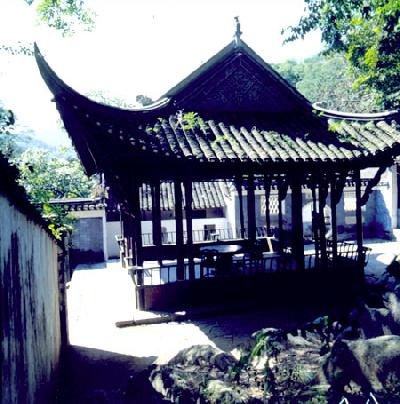
The Chinese pavilion,Ting,which is also named a kiosk, is built normally either of wood or stone or bamboo and may be in figures of square, triangle, hexagon, octagon, a five-petal flower, and a fan, etc.
Ting has a long history in China. Differing from the present functions, in the Zhou Dynasty (11th contrary-256 BC),Ting was a sentry at the frontier fortress for defense. Later, in the Qin and Han dynasties (about 200 AD),Tingchanged into a name for a certain institution in the countryside. It was in the Tang Dynasty (618-907) that Ting finally developed into a typical architectural style in Chinese landscape gardening.
All pavilions described as Ting have this in common: they have columns to support the roof, but no walls. In parks or at scenic spots, pavilions are built on slopes to command the panorama or on lakeside to create intriguing images in the water. They are not only part of the landscape but also belvederes from which to enjoy the scenery.
Ting also functions differently. The wayside pavilion is called LiangTing(cooling kiosk) to provide people with shade from the sun and protection from the rain, and also a place to rest. The ShibeiTing(stele pavilion) gives a roof to a stone tablet usually on which were engraved records of an important event. Ting also stands on some bridges or over water-wells.
Rare among pavilions are those built of bronze. The most famous of this kind is BaoyunGe(Pavilion of Precious Clouds) in Beijing's Summer Palace. The entire structure including its roof and columns is cast in bronze. Metallic blue in color, it is 7.5 meters tall and weighs 207 tons. Elegant and dignified, it is popularly known as the Gold Pavilion.
The largest Ting in China is also in the Summer Palace. The ancient building, named KuoruTing(the Pavilion of Expanse), has a floor space of 130 square meters. Its roof, converging in a crown on top and resting on three rings of columns (24 round ones and 16 square ones), is octagonal in form and has two eaves. With all its woodwork colorfully painted, the pavilion looks at once poised and majestic, well in harmony with the surrounding landscape.
InBeijing's Jingshan Park, there are five pavilions on the ridges. From east to west they are: Guanmiao Ting(Wonderful View Pavilion), Zhoushang Ting(Surrounding View Pavilion), Wanchun Ting(Everlasting Spring Pavilion), Fulan Ting(Panoramic View Pavilion) and Jifang Ting(Harmonious Fragrance Pavilion). From the hilltop, visitors can have a bird's-eye view of the city. There used to be a bronze statue of a god in each of the pavilions. Unfortunately four of them were stolen by the allied forces of the eight world powers in 1,900, and the one on the uppermost pavilion was totally damaged.
In modern times, kiosks (also called Ting in Chinese) have been erected in urban areas as postal stalls, newsstands or photographers' sheds for snapshot services.

Copyright ©1999-2011 Chinanews.com. All rights reserved.
Reproduction in whole or in part without permission is prohibited.