



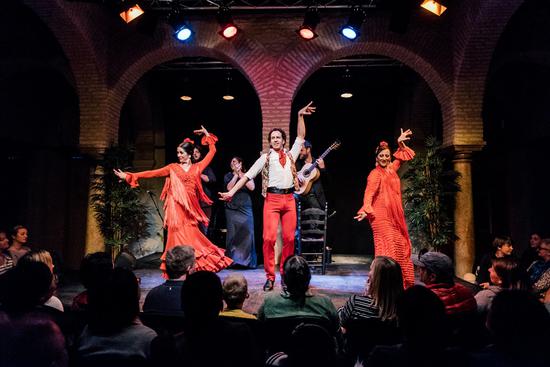

CNS: Flamenco is a representative art genre in Spain which was listed as an intangible cultural heritage of humanity. What do you think of the inheritance and worldwide spread of cultural heritages like Flamenco?
Kurt Grötsch: The roots of Flamenco, are based on a 3000 years history, going back to the Phenicians who brought the Castagnettes to Spain in the 1000 BC, the most original instrument in Spanish music. The Arabics conquered Spain in the 8th century and brought mainly singing and the Guitar to this country , but also the first dancing approaches. The Gypsies, emigrants from the Punjab region (India, Pakistan) arrived through the Silk Road in the 15th century in Spain and brought some Asian music and dancing elements into what will be called Flamenco in the early 19th century. The Flamenco, as we know today, started its evolution from the 17th century and developed mainly in Andalucia and Extremadura.
I was an university professor in Germany and taught Spanish and Latin American cultures. When I moved to Sevilla, I observed Flamenco as an art, but also as an economy or industry. There were a lot of spontaneous Flamencos, flamenco theaters (tablaos) and I became aware, that there was no physical or historical reference of this millennial art. So I suggested and pushed the creation of the Flamenco Dance Museum, where I have been the the director for nearly 20 years.
The company of the museum is on tour worldwide with about 3000 performances, including in the Poly Theatre in Beijing. Up to the 1990s, those were mostly private initiatives. Since 10 years ago, that is the Andalusian government (but also Madrid) that promote the Flamenco as genuine cultural and ethnographic heritage worldwide, also in China.
About 30% of the audience of the Flamenco Dance Museum are Chinese now. Some years ago, Tina Panadero, the CEO of the Flamenco Dance Museum and I made presentations and gave lessons of the flamenco in the Minzu University of China. Six month later a big exhibition was made, together with Spanish authorities in Beijing. This exhibition was brought to Spain and exposed in Sevilla, Malaga and Madrid. At the same time, six art teachers from the Minzu University of China were invited to stay for three months in Malaga, creating art works. The selected works were exposed in Malaga and Sevilla. Later I saw a painting of this experience in the Contemporary Art Museum of Beijing.
These are only two examples of how "integrated encounter and exchange" could be made, as the previous learning project is as important as the surprising results for the audience. The multiple concerts and performances of Chinese art and traditions in Spain, and the more and more Flamenco shows in China are beautiful, but lack of practical, contemporary artistic approach. New formulas should be developed. That is one of the reasons for me, being in Beijing these days.
CNS: On September, Spanish Prime Minister Pedro Sánchez paid an official visit to China. He expressed the expectation of strengthening exchanges in culture, education, science and technology to deepen mutual understanding and friendship between the two peoples of Spain and China. How do you see the Sino-Spain relations and the role of culture in promoting exchanges between the two countries?
Kurt Grötsch: I would say a catharsis is taking place what is creating a new approach not only on institutional levels but also on private levels between China and Spain.There are different factors we should consider.
Firstly, it is not the final figure in tourism, as Chinese tourists cannot compete with European travelers in numbers. It means that Chinese Tourism links Spain to China. It is a meaningful tourism that creates hope for that what comes after.
Secondly, the extraordinary work did on all levels to approach China to Spain by the Chinese ambassadors in the last years.
Thirdly, we are glad to see that the rising activities in number and quality of initiatives like "Catedra China" promotes the communication between Spain and China.
Spanish Prime Minister's visit to China last month indicates that a change of paradigma has taken place. This change should also been organized on more private levels, not only in economy and technology, but also in art and culture.
Edited by Wang Zonghan
2024.10.2






















 京公网安备 11010202009201号