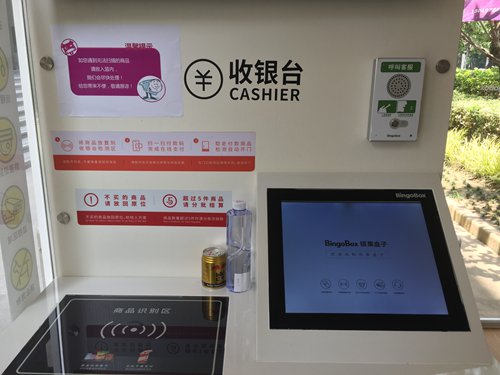
The barcode scanner zone and self-service cashier counter. (Photos: Yu Xi/GT)
In China, leading beverage company Wahaha, headquartered in Hangzhou, capital of East China's Zhejiang Province, is reportedly planning on opening 100,000 cashier-less convenience stores with integrated AI technologies within the next three years.
Chinese e-commerce giant Alibaba Group Holding displayed an unstaffed supermarket during its second annual Taobao Maker Festival in Hangzhou from July 8 to 12. However, there is no specific timetable for the launch of such supermarket yet.
According to Wang Xianqing, director of the Institute of Circular Economics at Guangdong University of Finance & Economics, self-service shops may boom in the short term as Alibaba's move to test the waters in return could incite other investors to enter into the sector.
Wang told the Global Times Tuesday that retailers are challenged by the need to better connect online and offline sales, which may be encouraging more retailers to open cashier-less stores.
Optimized business model
Increasing margin pressure is forcing retailers to reassess their staffing models by reducing the number of sales associates. This is expected to be realized via new technologies.
"New technologies such as radio frequency identification technology, digital payments, big data and AI" are adopted to change shopping habits as well as to save labor costs, Xiong Gang, chairman and founding partner of Shenzhen-based investment management company China ASB Ventures, told the Global Times on Tuesday.
At Tao Café, the checkout-free store showcased by Alibaba during the annual Taobao festival, more than 30 surveillance cameras are used to monitor in-store customers, according to the aforementioned CGTN report.
BingoBox said it has implemented smart technologies, such as AI, big data and "Internet of Things," into its business strategy in order to enhance customer service.
To do this, the company received 16 world-class patents, including action identification, anti-theft systems, and automatic settlement systems.
BingoBox believes that its facility can be profitable after the first month of it being in operation.
Xiong noted that cashier-less stores might have more advantages than the regular convenience stores in some first-tier cities where rent and labor costs are relatively high.
Challenges remain
However, obstructions lay ahead and improvements are needed.
"The cost of the cashier-less stores along with the advanced technology is also very high," said Wang, questioning its ability to generate profits.
Furthermore, it's still incalculable whether the cashier-less stores can truly bring more convenience to consumers than regular convenience stores, he noted.
Xiong agreed, saying that in some small cities, it's hard to say if the operation cost of cashier-less stores is lower than that of the regular stores.
"But what is certain is that the cost of the technology and daily maintenance is not low," Xiong noted.
One of the facilities run by BingoBox reportedly suspended operation on July 10 due to high temperatures inside the store.
The store has now restarted operation after the air conditioning was repaired. This demonstrates one of the limitations of this type of store as there is no staff present to report problems when they initially occur, thus weakening customer experience.
Some customers have also complained that counter scanners often fail to recognize the product's barcode, posing another drawback for the business model.

"The space is also limited, I'm afraid it can't contain many consumers in rush hour," said Wu, the abovementioned Shanghai resident.
BingoBox told the Global Times that it is still at the initial stage of development and that it will beef up efforts in improving management in order to strengthen customer experience. The company said the store with the air conditioning problem was one of their tests.
"As investors, we will be cautious toward self-service-related projects," Xiong said.