RIGHT BG

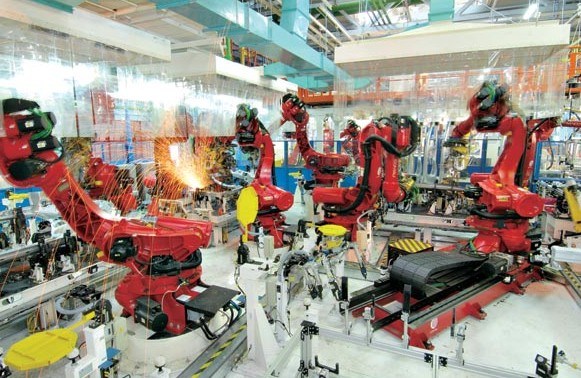
An engineer of Comau (Consorsio Macchine Utensili), an automobile manufacturing line producer and a client of Siemens PLM Software, uses the German company's software to conduct designing and for simulation experiment. Provided for China Daily
Development, servicing to eventual disposal is the ultimate goal, adds automation executive
Chuck Grindstaff, a US citizen who runs a German-backed industry automation company, sees China as his biggest market over the next decade for a software called lifecycle management that acts as a guardian of a product.
The chief executive officer of Siemens PLM Software, said China will be the company's top buyer of its products in 10 years although some Western entities are moving manufacturing plants back home.
"China is moving to a later stage of growth of high value and high quality manufacturing and an environment where innovation and engineering and creation of its own products are growing," said Grindstaff.
As more local companies start to understand the importance of innovation and cost control, Siemens PLM plans to receive more Chinese customers from next year.
The Plano, a Texas-based company, develops software used to manage the entire lifecycle of a product from designing, manufacturing, to deployment and disposal.
Machinery manufacturing is the best sector to showcase the beauty of PLM software.
Engineers and designers can use PLM software to build a yacht using a computer and send the blueprint to a shipyard. Workers at the shipyard will use the same system to monitor the building process and cut short the manufacturing time. Decorators can also use the PLM software to decide when will be the best time to move in the furniture so work on the floors won't be interfered with.
Even after the yacht is handed over to its owner, the lifecycle management software can continue to oversee the sea-worthiness of the boat and tell the sailors which parts need attention.
Following the same idea, PLM can be used in almost all manufacturing industries from space engineering to making shoes.
Chinese manufacturing companies, known for their high labor intensity and low development input, will be able to focus on product design and innovation and hire fewer entry-level workers on the front line, said Christopher Holmes, head of Singapore-based Asia-Pacific IDC Insights.
Turnover of the Chinese comprehensive PLM market reached $1.16 billion in 2012, representing a year-on-year increase of 16.2 percent, according to a Siemens estimate.
Yet PLM systems are severely underdeveloped in the world's second-largest economy famous for its role as the world's factory.
China accounted for 3.5 percent of the overall share of the global comprehensive PLM market last year.
The nation's export-oriented economy has been hit by the global economic downturn since 2008.
"China needs to build an innovation-driven manufacturing industry to put more added-value into its exports," said Holmes.
Traditional manufacturers in China will require new technology to keep their global competitiveness, he said.
According to a HSBC Holdings Plc report, China's manufacturing Purchasing Managers' Index, a gauge of domestic manufacturing activity, may decrease in December from an eighth-month high in November.
Data from the National Bureau of Statistics indicated the manufacturing PMI was 51.0 in December, the lowest one in 2013.
"Because China's economy remains export-oriented, the employment rate and earnings in the private sector are closely related to the global economic atmosphere," said Holmes, adding that because the European Union and other major trade partners of China are still in recession, Chinese firms need better cost-control and higher quality.
More vertical sectors, such as healthcare and digital manufacturing, will need a PLM system to boost work efficiency.
"The global economy is kind of funny right now. The weather is changing on a daily basis. This does put some pressure on the timing of the projects but our business has been quite strong around the world," said Grindstaff.
"For us, it's the value that we can provide after the implementation and we are trying to lower the cost barrier to get more implementation," he said.
"As China is moving to further develop its aerospace and commercial jetliners, I would like to show our tools to the large number of potential customers in China."
Copyright ©1999-2018
Chinanews.com. All rights reserved.
Reproduction in whole or in part without permission is prohibited.