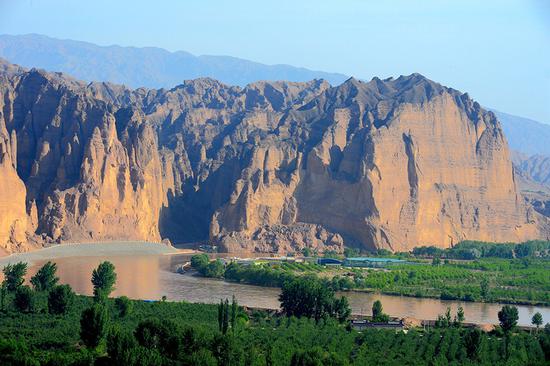
Magnesium alloy manufactured at Qairhan, China's largest salt flat, is expected to make autos lighter and greener, according to material researchers and manufacturers.
As the international auto industry eyes energy efficiency and emission reduction, the magnesium alloy business of the salt flat, in northwest China's Qinghai Province, may provide a new solution, according to Woods Glen with Hatch Engineering (Shenyang) at a forum last week.
The event, centering on lightweight automobiles and green energy, was held in Golmud, Qinghai, ahead of National Low-Carbon Day which falls on Tuesday.
If a car is 10 percent lighter, its energy consumption can drop by 6 to 8 percent, according to Lin Yi with China Auto Lightweight Technology Innovation Strategic Alliance.
"As the lightest usable metal material, magnesium can effectively shield electromagnetism and be easily recycled," Lin said. "Magnesium alloy will be a key to making cars lighter."
The wide application of the material in car manufacturing in China has long been hamstrung by a lack of a magnesium supply. However, the scarcity is likely to be relieved after a production project started at Qairhan Salt Lake at the end of 2016.
Located in the southern part of Qaidam Basin, the lake has more than 4 billion tonnes of magnesium.
"The project currently can yield 100,000 tonnes of magnesium a year, and the capacity will climb to 1 million tonnes in the future," said Xie Kangmin, president of Qinghai Salt Lake Industry Company. "That will be a sustainable and stable supply."
Traditionally, magnesium is extracted from mines, but the output is unstable and it is a high-carbon process.
"Obtaining one kilogram of magnesium using the traditional method generates 26 kilograms of carbon dioxide, while extracting 1 kilogram of the substance from salt lake water generates only 6.5 kilograms", said Yu Guoli with the Qinghai Magnesium Corporation, a branch of Qinghai Salt Lake Industry Company.
Rapid development of new energy vehicles (NEV) in China has also expanded opportunities for magnesium alloy in auto manufacturing.
Industry insiders estimated that NEV would account for about 40 percent of autos produced and sold in the country in 2030.
"If a vehicle is lighter, its battery can be used longer," Lin said. "I believe more NEV makers will choose parts made from magnesium alloy in the future."
"We are using magnesium alloy components in steering wheels and seats, and will promote their use in other parts of the car," said Guo Qiang, a R&D manager at auto maker BYD.
Currently, a Chinese-made auto uses less than 4.5 kilograms of magnesium on average, but the number is expected to reach 15 kilograms in 2020 and 45 kilograms in 2030, according to Zhen Zisheng with Magontec Xi' an Company.
"It means China's demand for magnesium alloy may reach 350,000 tonnes in 2020 and exceed one million tonnes in 2030," Zhen said.
"The magnesium alloy business at the salt flat is a unique advantage for China's automakers. It may fuel a green revolution of the industry," said Yang Jie, deputy secretary general of the China Auto Lightweight Technology Innovation Strategic Alliance.