(Photo/Shanghai Daily)
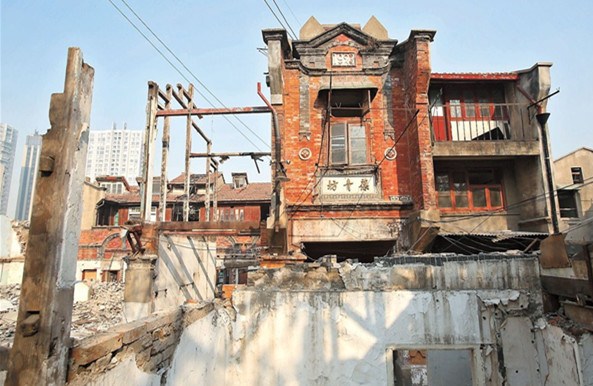
In March of 2017, Jianye Lane, one of the earliest residential compounds in the city's former French concession, built in the 1930s, will reopen to the public as an urban resort following eight years of extensive renovations. Named Capella Shanghai, the luxury hotel will have 55 villas and be attached to an upscale spa, a high-end French restaurant and venues for private activities. However, the renovation of Jianye Lane has aroused disputes among architectural conservationists in town who decry it as a "fake antique" of market-driven exploitation.
Ruan Yisan, a professor at Tongji University, told the Xinmin Evening News that the development of Jianye Lane was not handled well.
"The newly renovated Jianye Lane is just a fake antique," said Ruan, a well-known architectural conservationist.
According to Ruan, the protection of historical architecture should follow certain principles of authenticity, integrity, sustainability and historical readability.
Thus the renovation of Jianye Lane should have tried to maintain its original materials, craftsmanship, style, structure and environs, like the city did with the restoration of HSBC, Fairmont Peace Hotel and other buildings on the Bund.
"However, I can't see the preservation of historical information in the renovation of Jianye Lane. It is like a wax figure that only copies the appearance but has no life," Ruan noted.
Jianye Lane, located at west of Yueyang Road and north of Jianguo Road West in Xuhui district, was originally designed for 200 households.
Gradually, over the decades as a result of societal turbulence, it became home to 1,000 households. The smallest household lived in a space of merely 8 square meters and had to share its kitchen and toilet with families.
From 1976 to 2003, Jianye Lane did not receive much proper maintenance, according to its residents, and problems such as leaking roofs and a blocked sewer system were common. The compound was officially recognized as a historical heritage site in 1994.
According to the Shanghai Business Daily, in order to improve living conditions, in August of 2003 Xuhui district authorities encouraged residents of Jianye Lane to relocate to other places by providing them with subsidies.
About 600 households moved out at the end of 2004; 400 families said they wanted to stay.
However, the ideal plan of local authorities was to reduce the number of households down to 200, then update the compound with proper facilities such as new gas mains and modern-style toilets.
But this never happened, and between 2004 and 2007 Jianye Lane entered into a state of stagnation.
In 2007, the renovation of Jianye Lane was restarted after Portman Holdings entered with three local real estate developers.
Their intent was to turn it into a multi-functional commercial compound of offices, hotels and some residential buildings by 2010.
During the process, the eastern section of Jianye Lane was completely torn down while the western end remained intact for the residents who still lived there.
From time to time banners put up by families saying "give my home back" could be seen around the construction site but were quickly torn down by the developers.
Construction was completed in 2012, however it never formally opened to the public. It sat there as an unused ghost community; a dark secret among local real estate developers who refused to release any updated information about their intentions.
The Oriental Morning Post reported that the 2012 renovation of Jianye Lane had involved a panel of architectural protection experts including Zheng Shiling, director of Expert Committee for the Preservation of Historical Areas and Heritage Architecture of Shanghai.
The municipal government had in fact, back in 2008, officially approved the panel's decision that the eastern and middle sections of Jianye Lane should be "dismantled and restored and be equipped with underground parking garage to improve its supporting facilities."
Zheng said that during the initial restoration process some parts of Jianye Lane were not rebuilt in their original appearance.
"It is acceptable to tear down some parts of traditional buildings, but it is improper to start the dismantlement of preserved architecture," Zheng told the Oriental Morning Post.
Zheng was not satisfied with the renovation plan proposed by Portman Holdings, accusing them of being unfamiliar with traditional Chinese lane housing, the Oriental Morning Post reported, and that the panel had no right to make any final decisions for Jianye Lane.
In the eyes of Professor Chang Qing from Tongji University, the development of Jianye Lane - which was co-planned by local government officials and Chinese and foreign real estate developers - serves as one of the four major modes to protect historical buildings in the city, the Xinmin Evening News reported.
The other three modes are "Xintiandi mode" that aims for creative development rather than protection by redesigning not only the framework but also the whole interior of shikumen (stone-gated style) buildings; "Tianzifang mode" that maintains original residents in the upper floors and leases ground floors for commercial use; and "cultural relic protection mode" that involves governments and cultural relic protection departments taking the lead to maintain the exact appearance of the architecture, which have been recognized as cultural relics.
Only those architecture identified as cultural relics, such as Yuyang Lane and Bugao Lane, are likely to be completely preserved, Chang said, while the destiny of other traditional shikumen buildings often must struggle between protection and market-driven exploitation.
Chang noted that whether Shanghai's old shikumen compounds will regain vitality while maintaining their traditional characteristics depends on the city's policies for community renewal.