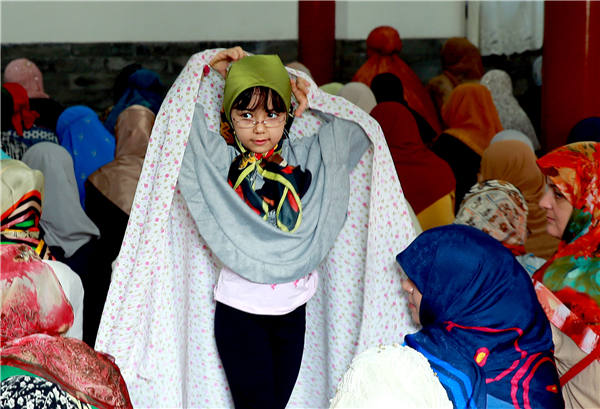
People attend the Eid al-Adha Festival at Beijing's Niujie Mosque on Monday. The festival is one of the most important dates on the calendar for Muslims.(Photo by ZOU HONG/CHINA DAILY)
Reception was held to mark festival; believers gather for prayer sessions
Muslims across China celebrated one of Islam's biggest holidays on Monday as they gathered to pray and sacrifice halal domestic animals in accordance with religious dietary laws.
The Eid al-Adha Festival, or the Feast of Sacrifice, is one of the most significant dates on the calendar for Muslims. It is marked by wearing new clothes, taking part in morning prayers and sacrificing sheep or cattle.
The Islamic Association of China held a reception in Beijing on Monday evening, inviting State dignitaries, including Vice-Premier Liu Yandong; Sun Chunlan, head of the United Front Work Department of the CPC Central Committee; and envoys from some Islamic countries.
Chen Guangyuan, president of the association, addressed the celebration by extending his greetings to Muslims globally.
In Beijing, where authorities estimate that there are at least 260,000 Muslim residents, thousands of believers gathered at the Niujie Mosque to perform morning prayers on Monday.
"It is also a time of showing loyalty to your country and Allah, and showing filial piety to your parents," said Su Quanren, a 42-year-old Hui resident in Beijing.
Su, a migrant worker from Lanzhou, Gansu province, said he would have been celebrating the festival with his family if he were in Lanzhou.
"Even though I am alone here in Beijing, I take part in the prayers together with my friends," he said.
The Niujie area, a neighborhood largely inhabited by Hui people in the capital's Xicheng district, has Beijing's largest concentration of Muslims.
Nur Syafika Mohd Rasid, a 19-year-old overseas student from Malaysia who is studying Mandarin at Beijing Foreign Studies University, said she decided to come to the mosque for the Eid al-Adha, as it is one of the oldest mosques in Beijing and she can meet other Muslims there for the celebration.
"It unites us. We meet different people, different cultures and different languages, of course. That is interesting."
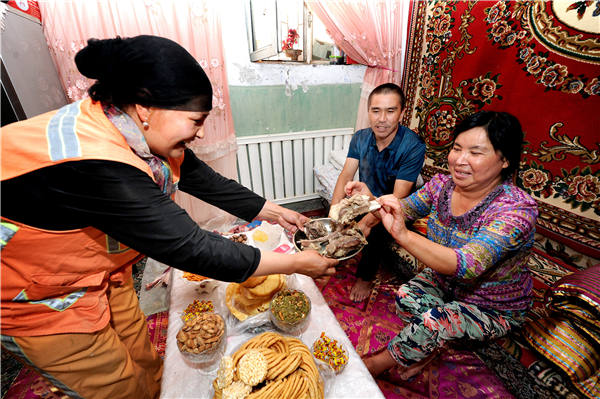
The festival is also celebrated widely in the Xinjiang Uygur autonomous region.
Mamat Xerip, a 78-year-old resident of Urumqi, said all male adult Muslims would take part in the morning prayer sessions at the mosques.
"The festival is also an occasion to remember and mourn your dead relatives," he said.
Eid al-Adha is an important four-day religious holiday observed by Muslims. It marks the end of the Hajj, the annual pilgrimage to Mecca.
China has more than 20 million Muslims, who mainly live in the western provinces of Qinghai, Gansu and Yunnan, and in the Xinjiang Uygur and Ningxia Hui autonomous regions.