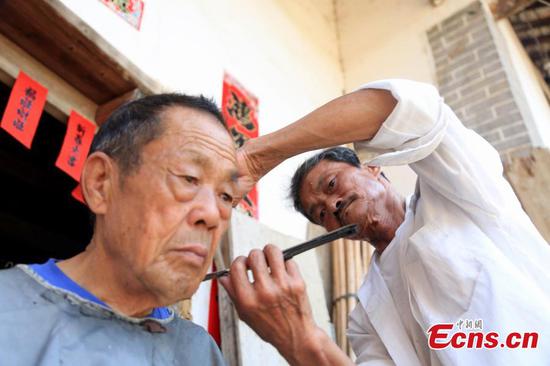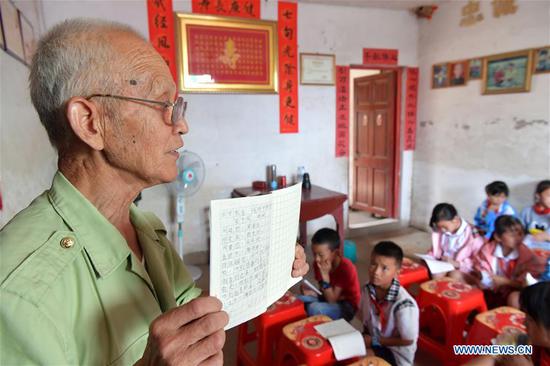
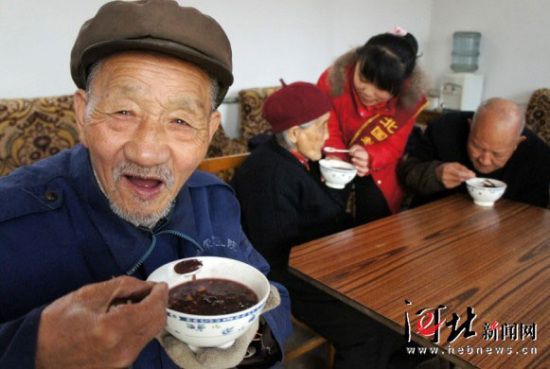
A senior at a nursing home in Hebei province. (Photo/hebnews.cn)
China is moving towards an old-age crisis as the country rapidly ages. Despite skyrocketing demand, firms trying to expand or start care homes are facing not-in-my-backyard protests. The demonstrators believe that these old people's homes will push down house prices and even bring "bad luck" to an area. Care home managers have asked the government to do something to eliminate these superstitions and to help the sector grow so China's elderly can receive the care many of them need.
China desperately needs to develop a greater capacity to care for its old people. However when local governments and businesses attempt to bring these services to communities, they are often met with protests.
China has the largest elderly population in the world, with the number of citizens over 60 totaling 220 million by the end of 2015. This figure is projected to surpass 300 million by 2025.
Despite this demand, work on an elderly care center in a residential community in Haikou, capital of South China's Hainan Province, has been suspended for three months due to protesting locals.
The mostly elderly or middle-aged protestors are holding rallies and obstructing work because they worry the nursing home will appropriate their public utilities and bring contagious diseases and bad luck to the area.
Some locals are particularly worried about the prospect of lots of people dying in the home.
Death remains a taboo topic in China - one way this manifests itself is that many elevators in the country do not have a "4" button, as this word is a homonym for death in Chinese.
The company behind the planned project, Fullcheer Senior Industry Development Co., Ltd, a Hunan-based private firm, has guaranteed local residents that the facility will not provide hospice or mortuary services, but their efforts were in vain.
"We feel helpless. We've gotten official permission for this project. The government has gotten involved in the mediation, but it is progressing slowly," Fullcheer CEO Huang Zihan told the Global Times.
Such protests are not unusual. Major cities including Shanghai, Chongqing, Nanjing, Hangzhou and Changchun have witnessed similar demonstrations against care homes for the aged.
"As integrated center- and home-based senior care services are promoted nationwide, such conflicts will certainly increase unless the government does something," Wang Xiaolong, president of the Beijing-based Cuncaochunhui Home for the Aged, told the Global Times.
"Many people aren't aware of the benefits of this service mode. Local governments fail to publicize the service and fight against the illegal violent obstructions," he added.
In demand
In 2011, Wang and four of his Tsinghua University classmates invested more than 10 million yuan ($1.5 million) on renting a house in central Beijing and turning it into a care home for the elderly.
He said some people living near the home objected to it at first, but they have come to accept it. All of the center's 100 beds are now occupied and there is a 700-person waiting list, Wang said.
Most of the center's elderly residents previously lived nearby. Most elderly people prefer to stay in care centers in their communities, and many will not move to homes if they are too remote.
According to a report released by the China Research Center on Aging last year, there are about 5 million beds in China's old people's homes, but nearly half of them are vacant. The report blames this on the fact that many centers are either too expensive or are located on the outskirts of cities.
"Community-based centers also deliver a range of services such as meals, nursing care, rehabilitation services and personal care to patients who are still living in their homes," Wang said, adding that his center cares for around 5,000 such elderly people.
This works well with the Chinese culture of care, as many families see sending an elderly member of the family to receive care in a facility as "unfilial."
This system efficiently uses the resources of families, the country and the market, he added.
The monthly cost of live-in care at the Cuncaochunhui Home for the Aged is between 3,000 yuan to 5,000 yuan depending on the senior's needs, according to Wang.
Several elderly people told the Global Times they hope such services were available in their communities. "If we could enjoy professional care at home, the children could go to work and on outings without worrying about us," said Yan Ruiying, 75, a resident of Changsha, Hunan Province.