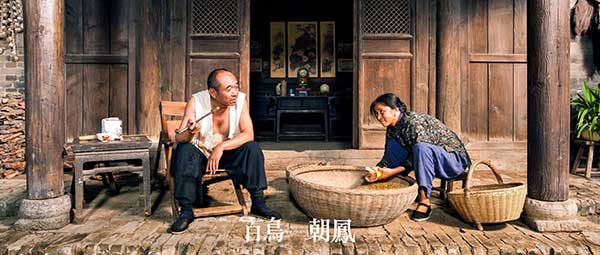
(Photo provided to China Daily)
Two years after prominent filmmaker Wu Tianming's death, his last directorial work will debut in the country's cinemas on Friday.
Wu, 74, died of a heart attack in Beijing on March 4, 2014, just a month after he finished Song of Phoenix.
The film revolves around an elderly suona (double-reed horn) performer's aim to pass on the art form amid its falling popularity in modern China.
"Wu was a remarkable and courageous man. He deserves to be not only remembered, but celebrated," says American director Martin Scorsese, in a video promoting the movie.
He was a man who stood up for his belief in freedom, freedom of expression and great human freedom, says the Hollywood icon.
"And, I share that belief."
Wu's name may not be well known to younger Chinese viewers, but he is widely hailed as one of the most influential and significant figures in Chinese cinema.
The former head of Xi'an Film Studio was instrumental in encouraging directors like Zhang Yimou and Chen Kaige after he took the position in 1983.
His studio reforms, which cut red tape, helped young filmmakers of that time to flourish and thrive.
There were many such instances, some of which were reported by the media.
In 1987, Zhang ran out of money while shooting his directorial debut Red Sorghum-which became the first Asian film to win a Golden Bear at the Berlin International Film Festival in 1988.
Wu then raised 40,000 yuan ($6,100) for Zhang, a big sum at the time.
Zhang, speaking in another video, says Wu "changed his life and destiny".
Seen as the "godfather" of China's fifth-generation directors, including Zhang and Chen, Wu is also noted for his in-depth look at China's rural life.
Wu's top films include the award-winning Old Well and The King of Masks.
Typical of the characters in his films, Wu stood out as a guardian of tradition who refused to sacrifice his art to cater to the box office.
Veteran director Huang Jianxin, who was among those supported by Wu in the mid-1980s, says: "Song of Phoenix mirrors Wu's struggles in real life, his persistence and his seriousness when speaking up for China's traditional arts.
"Wu was very protective of young filmmakers when he headed Xi'an Film Studio. Thanks to his selfless efforts, we could become part of China's golden era of cinema," adds Huang, who shot to fame with his 1985 film The Black Cannon Incident.
Hong Kong veteran Tsui Hark said Xu was "a brave and serious man who devoted his life to the Chinese film industry".
He made the comment at a recent event in Beijing, where he was with Huang to promote Wu's last movie.
Jia Zhangke, a pioneering art-house director, says Wu's films were simple and effective, displaying his deft narration and editing skills.
"I believe every viewer will fall in love with suona music after watching Song of Phoenix. It showcases a strong belief in Chinese culture and a sincere love of the country," Jia said in Shanghai earlier.
Several previews of Song of Phoenix have been held in Beijing, Shenzhen and Shanghai recently and the movie has received acclaim from both viewers and critics.
But industry sources are concerned that the art-house film may be squeezed to a small number of screens by its powerful rival Captain America: Civil War.
The biggest blockbuster in Marvel's cinematic universe will open in China on the same day as Wu's film.