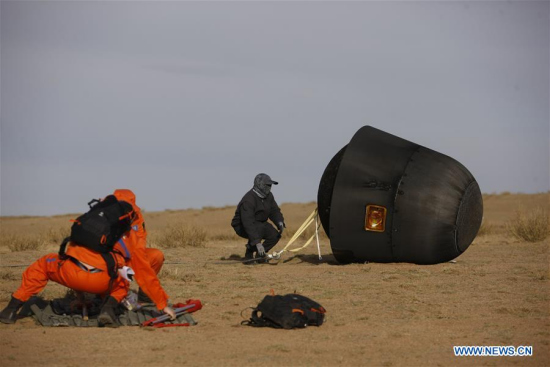
Scientific personnels work at the landing area of the re-entry capsule of China's first retrievable microgravity satellite SJ-10 in Siziwang Banner, north China's Inner Mongolia Autonomous Region, April 18, 2016. The satellite returned safely to Earth on Monday, marking a solid step forward in China's space science research and application. (Xinhua/Chen Junqing)
The re-entry capsule of China's first retrievable microgravity satellite, SJ-10, returned safely to Earth on Monday, marking a solid step forward in space science research and application.
The recoverable capsule from the research probe, launched on April 6, touched down at around 4:30 p.m. at the planned landing area in Siziwang Banner in north China's Inner Mongolia Autonomous Region, retrievers said.
The capsule was transferred to the China Academy of Space Technology (CAST), which will hand over the equipment aboard the capsule to the Chinese Academy of Sciences (CAS) for further analysis and assessment.
The re-entry capsule separated from the orbital module of the probe about 15 minutes before its landing. The latter will remain in orbit before burning away.
It is the 24th retrievable satellite China has successfully recovered. The landing also marked the first time such a satellite has been recovered in Siziwang Banner.
During its 12-day journey in space, 19 experiments on microgravity and life sciences were carried out on board.
The experiments included one on the early development of mouse embryos in microgravity to shed light on human reproduction in space, and another on space radiation's effect on the genetic stability of fruit flies and rat cells.
Zhao Huiguang, chief architect of of the SJ-10, said the move forecast a new "spring" for the nation's retrievable satellites project.
SCIENTIFIC EXPERIMENTS
For the former experiment, the probe carried over 6,000 mouse embryos in a self-sufficient chamber the size of a microwave oven, according to the CAS.
According to the pictures sent back from a high-resolution camera, the 600 embryos, which were put under the camera, developed from the 2-cell stage, an early-on embryonic cleavage stage, to blastocyst, the stage where noticeable cell differentiation occurs, around 72 hours after SJ-10's launch. The timing was largely in line with embryonic development on Earth, according to CAS.
This is the first reported successful development in mammalian embryos in space in the history of science.
The 15 pieces of equipment which carried 11 experiments loaded on the capsule were in good condition after experiencing the harsh space environment and the return trip.