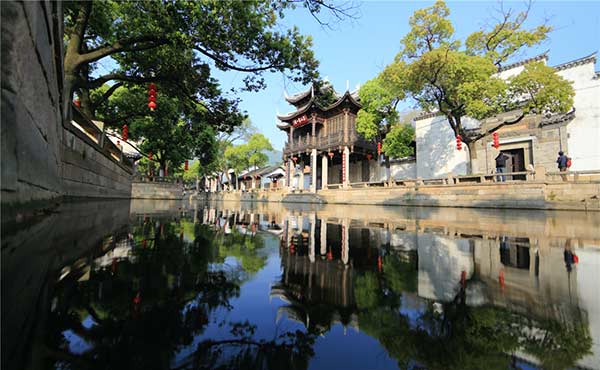
The Guo ancestral temple is one of the 118 temples in picturesque Huishan. The 0.3-square-kilometer town, which lies at the foot of Huishan Hill, has been considered a valuable feng shui site since ancient times. According to the traditional Chinese system of achieving harmony with the surroundings, those who are buried at the foot of the mountain enjoy peace and bestow fortune on their descendants.
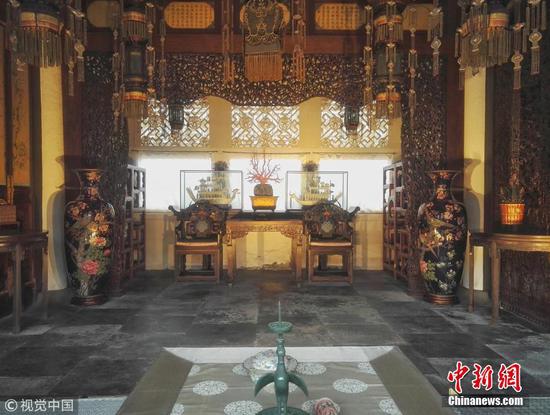
The ancestral temples, lined up along a branch of the ancient Beijing-Hangzhou Canal, vary significantly in size, architectural style and date of construction.
The largest temple, Jichang Garden, covers an area of 9,000 square meters. It is also one of the country's most renowned gardens and receives millions of visitors every year.
Most of the temples in the town were built in line with traditional Chinese architectural principles. Others, constructed in modern times to commemorate famous businesspeople, such as Yang Oufang, one of the country's earliest cotton-spinning factory owners, reveal strong Western building influences.
The oldest temple dates to the Han Dynasty (206 BC-AD 220). It was built to commemorate an emperor who contributed greatly to flood control in the area.
"Visitors can learn Chinese history and get a glimpse of traditional Chinese culture at these ancient halls," said Li Wenyang, a specialist of cultural studies who has written a book about the 138 historic figures commemorated at the 118 temples.
"We have more than 20 types of ancestral temples here in Wuxi," Li said. "They cover almost all temple types except for the imperial one. We have temples to remember ancestors, commemorate ancient people known for their merit and even one to worship the god of flowers for bumper harvests."
In Hefei, capital of East China's Anhui province, Xu Chun and members of his clan have been busy preparing their annual tribute to ancestors as part of Tomb Sweeping Day, which falls on April 4.
"Tomb-sweeping activities in China are usually conducted before Spring Festival and during the Tomb Sweeping Day break. The first is often conducted by small families, while the later date is more suitable for large-scale ancestor worship rituals," said Xu, 48, a resident of Hefei.
Some members of the family were responsible for contacting their various relatives. Others helped prepare the sacrifices and other items needed for the ceremony.
"We all volunteered for the work and never expected or asked to be paid," Xu said.
The ceremony will be held in the family's ancestral temple in Leima community in Hefei's Shushan district. Hundreds of family members from across the country are expected to take part.
"If we didn't repair the temple in 2008, it would have collapsed and we would have no place for such a gathering," Xu said.
In Leima, which was previously a township, there are now about 10,000 residents, of which about 3,000 are from the Xu family. Other large clans in the area include the Zhou and Gu families.
"There is an old saying here, 'Don't fight the Xus at any time', because they are a very large and united family," Xu said.
"We are united partly because the ancestral temple reminds us of our family ties."
The Xu temple was first built about 1547. It was badly damaged in the 1850s during the Taiping Rebellion (1850-64), and in 1939 during the War of Resistance Against Japanese Aggression (1937-45).
"Every time it was damaged, it would get repaired soon after," said Xu Jiacai, 72, who still remembers the important role of the temple when he was young.
"It was not only a place to keep the ancestral tablets. It was also where the clansmen discussed important family issues."
Xu Jiacai said he once witnessed the whole scene of a prodigal son of a family member who was tied to a tree in the courtyard of the temple and beaten by seniors as punishment for his actions.
Huge swaths of farmland around the temple were also rented to tenants. The rent was enough to maintain the temple and family members did not need to donate money often for its upkeep.
After the founding of the People's Republic of China in 1949, two-thirds of the family temple's structures were taken up by a local hospital before being demolished to make way for new buildings.
In 2008, a rare blizzard hit a vast part of the area and affected the site badly. Xu Chun and several other clan members realized they had to repair their temple as soon as possible.
"We knew that we needed a lot of money to repair it," Xu Chun said.
He was initially not sure if they could get enough support for the repairs. Many local residents had moved to the city and beyond because of rapid urbanization.
To Xu Chun's surprise, hundreds of clan members pledged their support, together donating about 450,000 yuan ($69,100). Renovation work started at the end of 2008.
Some members also took part in the renovation work themselves, working for free.
"The ancestors will see what we have done for them, and they will bless us in heaven," Xu Jiacai said.
Traditionally, when a family member died, a tablet that embodies his or her spirit will be made and placed in the temple. The ancestral tablets are typically arranged according to seniority.
In the Xu ancestral hall, the tablet of the most senior ancestor belongs to the one who first started living in Leima. The other tablets belong to the three generations of his descendants. There are no tablets for the later generations because more time and space are required for them.
Xu Jiacai said he looks forward to the day when the hospital buildings can be removed and the temple is able to recover its original scale.
"Urbanization will inevitably distance our clan members, but I think they will get more curious about where they come from. They will attach even more importance to the ancestral halls in the future," the senior Xu said.
A new urban district is officially being planned in Leima and most of its remaining rural structures are expected to be demolished.
Fortunately for the Xu family, their ancestral hall has been listed as a protected cultural relic — ensuring its presence for future generations.
More than 10 temples in Huishan have also been listed as key cultural sites under State protection. Specialists of cultural studies and local government employees are working hard to prepare for a UNESCO World Heritage application to better protect the town.
"It's rare for so many ancient temples to be situated in a small town," Li Wenyang said. "We hope that by protecting the temples, we can also help people retain their traditional values.
"The ancient temples are a physical record of our merit, achievements and experiences. They are like museums, offering history silently to people who are interested in learning more about themselves."