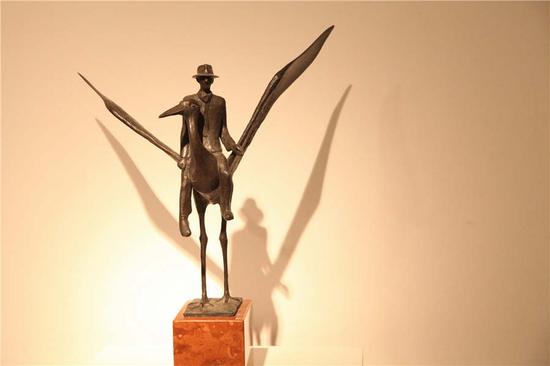
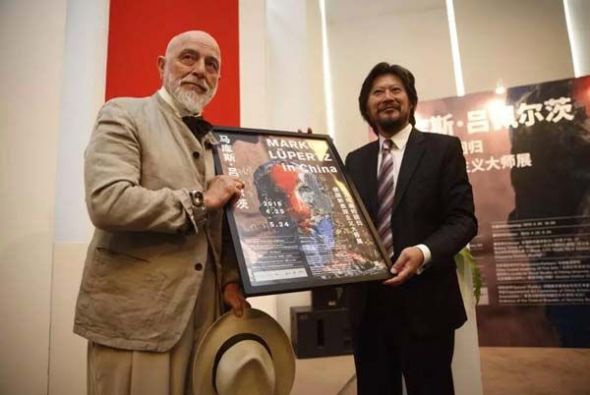
Neo-Expressionist artist Markus Lüpertz (L) shows his works in Beijing. (Photo/CCTV)
Neo-Expressionist artist Markus Lüpertz is visiting China's capital with 81 of his works from over the years. The German artist is in his 70s and is known for his cross-over artistic talents, his high taste in fashion, and most importantly, the initiation of a revival of European painting.
The exhibition at Beijing's Times Art Museum is Markus Lüpertz's biggest collection ever on display in China.
Hailed for his Neo-Expressionist style, Markus Lüpertz and his paintings emerged in Europe in the early 1960s. Before that, it was a time known as the "end of the painting".
Lüpertz initiated a painting revival. He believes that painting can carry meaning of what words cannot.
"It's the items in the painting that speak for themselves, not that artists giving meaning to them. No matter whether it's armor or a helmet, it stands on its own to mean something," he said.
In the late 1970s, Lüpertz began to address the subjects of war and Nazi dictatorship. Broken statues, helmets, sullen faces and naked bodies are usually seen in his works. But he refuses to interpret his works to audience members. As he believes "one can not make art understandable."
Neo Expressionism has its roots in European tradition, and is recognised as a resistance in Europe against the inundation of American pop art.
"There is no such thing as international art. If there is an international cuisine, it would be awful to eat. So national borders don't divide art, cultures and regions do," he said.
This is Lüpertz's second time in China. And he is a little bit disappointed to see that Beijing turned out to be no different from any other metropolis around the world.
However, he has kept his lasting focus on both traditional and contemporary arts of China.
"I'm very curious and interested in Chinese classical arts. I have a horse statue from Han Dynasty at home. Chinese artists have made a lot of breakthroughs over the years. Yet what is a shame is that many Chinese artists tend to focus on how Westerners look at them and as a result lose their unique cultural expression. But it's great that Chinese collectors like to collect art from their own country," he said.
The exhibition runs to May 24 at Beijing Times Art Museum.