RIGHT BG

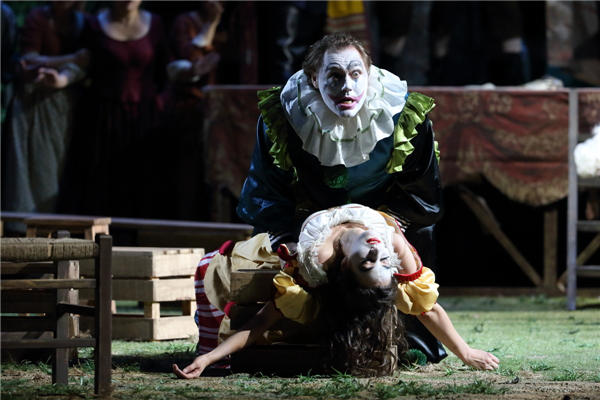
At the end of Pagliacci, Canio kills his unfaithful wife Nedda in a fit of rage.
The plots of Cav/Pag - as the double bill is popularly known in its short form - uncannily mirror each other. In Cav, a jilted girlfriend takes revenge on her disloyal man, and in Pag it is the tormented husband who ends up killing his wife and her lover.
In terms of style, verismo - of which the two operas are representatives - has gained less exposure in China than, say, even some baroque operas. Of course, that will require you to exclude Puccini, who is indisputably the reigning king on the NCPA opera stage.
NCPA's Cav/Pag backed up its traditional stage design with solid casting. The foreign cast that I heard was very strong, with Violeta Urmana playing the female lead Santuzza in Cav and bringing a shining ray of star power. The Turiddu of Jorge de Leon and the Alfio of Luca Grassi were equally strong.
Wang Hongyao acquitted herself admirably as Lola, who is Turiddu's old flame and derives much evil pleasure from troubling Santuzza. She is heard before coming onto the stage and both her voice and her physical charm make the story convincing.
It is a culturally fascinating coincidence that another Chinese singer, Liu Songhu in this case, played the seducer in Pag. But Liu is less believable both physically and vocally. In this opera, Brigitta Kele as Nedda stole the spotlight. She imparted the cruelty of youth and beauty in coloratura flights of fancy and matching physicality.
Gustavo Porta as Canio and Luca Grassi as Tonio had their own moments of glory.
The second cast, which rotated with the first, featured an all-Chinese ensemble of singers - opera stars of the highest caliber China can offer.
I did not have the good fortune to witness their performance but they often deliver pleasant surprises of their own.
Maestro Fabrizio Maria Carminati conducted the NCPA orchestra with passion, and the center's chorus rendered an expressive and nuanced performance.
Copyright ©1999-2018
Chinanews.com. All rights reserved.
Reproduction in whole or in part without permission is prohibited.