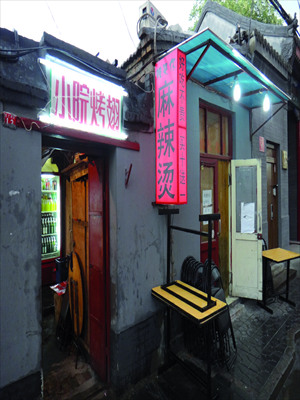
Malatang and Xiaoyuan are definitely reasons to visit this lane.
All the hutong around Dongsi Beidajie are worth a visit, but one particularly stands out, that being Weijia Hutong. Don't be alarmed by the gigantic modern government building of Dongcheng district that lies at one entrance to the hutong - a quick walk down will reveal how different the actual lane is.
The hutong is most commonly associated with Ma Huitang (1870-1939), who was in charge of the construction of the Summer Palace in the late Qing Dynasty (1644-1911). This was just one of his many projects in Beijing. From temples, altars and even the prince mansions, Ma left his mark all over the city. His own abode, situated at No. 18 on the lane, was almost as spectacular as some of his other works. Ma built an elegant garden with pools, trees and fake mountains that occupied around 4,500 square meters out of his 8,000-square-meter home in the 1910s.
The grandeur of Ma's residence suffered when Mao came to power and any sign of privilege and opulence was frowned upon and often destroyed. Just a few decades after Ma's death, his choreographed gardens were ruined during the Cultural Revolution (1966-76).
Today No. 18 is occupied by many families. Its courtyard layout has gone and the traditional front gate has also been replaced by an iron door instead. Only an old Manchurian Catalpa tree inside the gate remains as a testament of the glorious past.
Next door at No. 19 is a kindergarten. It is one of the oldest kindergartens in Beijing, called Weijia Kindergarten, and has been around for half a century. Although it has recently been renovated, local residents said that the original architectural style partially remains.
A 60-year-old resident named An said that the lane is a combination of rich and poor. "As you can see on the east side of the lane big courtyards like No. 18 and 19 are assembled, while on its west side there are mostly modest houses," he said. "This is because the west was under the influence of neighboring Nanjianzi Xiang, where workers who made scissors would gather."
History might have changed the character of all these spots, but new life has been injected into the lane in the process, most noticeably in the food scene. The Xiaoyuan roast wing restaurant and Malatang hotpot restaurant on the east side of the lane are popular places.
Xiaoyuan is located at No. 13 and serves up tasty food on sticks. The door and inner courtyard are so shabby and small that it is hard to believe a restaurant could be found here. Yet its big red sign gives you a clue.
Like other popular hutong restaurants, it is best to avoid the peak times during lunch and dinner if you want to find a free table. Having said that, the place does not exactly serve the most filling food, so it can easily be enjoyed outside the main meal times too. Either way, the signature tender roast chicken is enough to earn the restaurant notoriety in the area.
If you are feeling hungry after a visit to No. 13, the neighboring Malatang is also recommended, which serves chuanr dipped into spicy hotpot. Both the restaurants are very cheap, so dining at them will not burn a hole in the wallet.

Copyright ©1999-2011 Chinanews.com. All rights reserved.
Reproduction in whole or in part without permission is prohibited.